SENSEX Multi-Strike Open Interest | Live OI Across Strikes
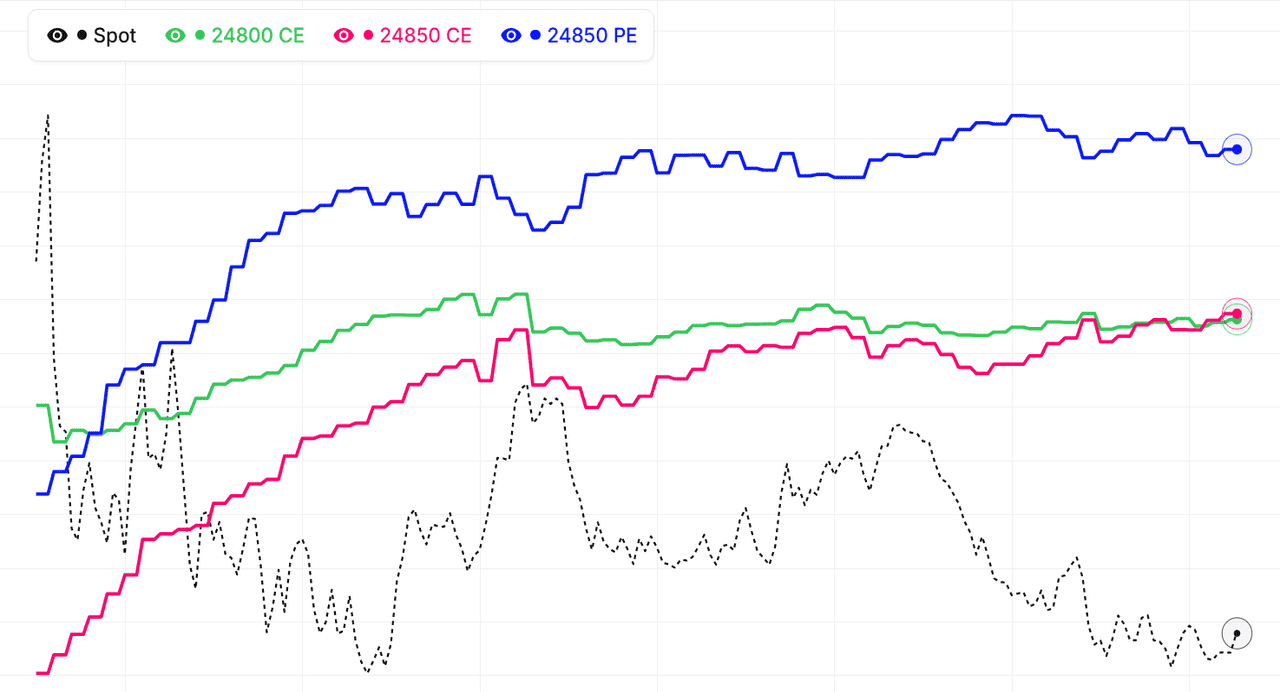
The multi-strike OI view for SENSEX shows open interest for several strikes on a single chart — the total OI footprint across the option chain instead of one strike at a time. This makes it easy to see how institutional positioning is distributed acrossSENSEX strikes: concentrated buildups reveal where writers are defending key levels, while OI unwinding across adjacent strikes signals that a directional move may be brewing as institutions exit structured positions.
Every strike's OI curve for SENSEX can be added, removed, or hidden, so you can focus on just the ATM band, the full ±5% range around spot, or specific far-OTM strikes you're watching for tail-risk hedging activity. You can track both total OI and OI change (the more important series for intraday reads), across all active expiries. Weekly expiries usually show faster, more reactive flows; monthly expiries show deeper institutional commitment in SENSEX option chains.
Reading the SENSEX multi-strike OI footprint
A heavy OI cluster at a SENSEX strike that's also showing rising total OI is a strong support or resistance reading — institutions are willing to sell more premium there, confident the strike will hold. When the cluster starts shedding OI (positive spot move into the strike but OI dropping), that's the classic unwinding signature that often precedes a breakout on SENSEX. The multi-strike view makes it obvious when this is happening at one strike or spreading across several. Live mode keeps each strike's OI updated across the NSE session.
Combine multi-strike OI with our Multi-Strike Volume, Total OI Chart, Smart OI Detection, and Live Option Chain to build a full picture of SENSEX NSE option-market positioning.
BSE Sensex (SENSEX) Multi-Strike OI: Historical Mode Analysis
Why replay historical multi-strike OI for SENSEX?
Historical mode lets you select any past trading date and see exactly how BSE Sensex multi-strike OI looked that day. You pick the date, the strikes, and the expiry, and the chart reconstructs the data. This is invaluable for studying how OI patterns preceded past SENSEX moves — a skill that is almost impossible to develop from live data alone because you only see one day at a time.
Study routine for SENSEX historical multi-strike OI
Each weekend, pick a significant BSE Sensex move from the past week or two. Open historical mode and replay the multi-strike OI from 3-5 sessions before the move. Note which strikes showed accumulation, which showed distribution, and when the pattern became clear. Did the multi-strike view give advance warning? If yes, what was the specific signal? Over 8-12 weeks of study, you build a catalog of recognisable patterns specific to SENSEX.
Comparing SENSEX historical and live patterns
The real value of historical study is pattern matching. When today's live multi-strike view looks similar to a historical pattern you studied, you have a higher-confidence setup. "This looks like the pattern before the breakout three weeks ago" is a far more useful thought than "I see some OI changes". Pattern matching requires familiarity, and familiarity comes from spending time with historical data.
Building a SENSEX pattern library
Keep a simple library of the patterns you identify. For each pattern, note: the date, the strikes involved, what the OI did, what BSE Sensex price did afterward, and a short description. Over months, this library becomes your personalized playbook. When live conditions match a library entry, you know what to expect. As of 29 September 2026, this disciplined approach is what turns the multi-strike tool from a visualisation into a trading edge.
BSE Sensex (SENSEX) Multi-Strike OI: Pro Tips
Tip 1: Focus on rate of change, not absolute OI
The speed at which BSE Sensex OI is changing at a strike matters more than its absolute value. A strike going from 1 lakh to 2 lakh OI in one session is more meaningful than a strike sitting stubbornly at 5 lakh for weeks. Rapid changes signal active interest; static high OI often reflects old positioning that has become irrelevant. Train your eye to notice rates of change, not just levels.
Tip 2: Watch the edges of the SENSEX range
The most informative strikes are usually at the edges of the active range, not the middle. Strikes at the highest put OI and highest call OI levels are the decision points. If these strikes see meaningful changes (accumulation or unwinding), the entire range is shifting. Middle strikes tend to be less informative because they are not actively being defended by anyone.
Tip 3: Build consistent SENSEX habits
Check the multi-strike view at the same times each day — opening (9:15-9:30), mid-morning (10:30), mid-day (12:30), and closing hour (2:30-3:30). Consistency beats randomness. By observing at fixed times, you build a mental model of how the SENSEX OI evolves through each session. This baseline makes it easy to spot unusual activity when it happens.
Tip 4: Journal your SENSEX multi-strike observations
Keep a simple trading journal. For each session, note: the strikes you watched, the patterns you saw, the trades you took, and the outcomes. Over weeks and months, you accumulate a personal database of what works for BSE Sensex. Generic advice is fine for learning the basics, but your own documented experience is what turns multi-strike OI into a real trading edge. As of 29 September 2026, the journal habit is one of the highest-value investments you can make. As a major Broad Market index on BSE, BSE Sensex rewards traders who pair consistent observation with disciplined recording.
BSE Sensex (SENSEX) Multi-Strike OI: Pre-Market Setup
Why prepare a pre-market SENSEX multi-strike plan?
Pre-market preparation separates disciplined traders from reactive ones. Spending 3-5 minutes setting up your multi-strike view for BSE Sensex before 9:15 AM gives you a clear framework before the first tick. You know which strikes to watch, which patterns to look for, and what will change your bias. Without this preparation, you spend the opening minutes reacting to every move instead of following a plan.
Step 1: identify key SENSEX strikes from yesterday's close
Pull up yesterday's end-of-day option chain for SENSEX. Identify the top 3 call OI strikes and top 3 put OI strikes. Note where the current price sits relative to these strikes. Pick 6-8 strikes for your multi-strike view — the top 2-3 on each side plus 1-2 near the current price. This selection gives you a complete view of the options landscape you care about.
Step 2: note yesterday's SENSEX OI patterns
Look at what happened to OI in the final hour of the previous session. Did any strikes see large increases or decreases? These late-session moves often carry over into the next day. If put OI grew sharply at 22500 in the last hour yesterday, expect that level to matter today. If call OI was unwinding at 22800, expect that resistance to be weaker. These overnight clues often prove predictive.
Step 3: define today's SENSEX thesis
Based on the key strikes and overnight patterns, write a one-line thesis. Examples: "BSE Sensex likely to stay between 22500 and 22800 today — sell strangles inside that range." Or "Watching for breakout above 22800 — will trade long if OI at 22800 starts unwinding." Writing the thesis commits you to a plan. As of 29 September 2026, this simple discipline transforms chaotic mornings into structured ones.
SENSEX multi-strike OI patterns: quick reference
| OI pattern across strikes | Positioning | Common reading |
|---|---|---|
| Call OI rising at adjacent strikes above spot | Resistance wall building | Upside capped near the cluster until writers cover |
| Put OI rising at adjacent strikes below spot | Support wall building | Downside defended near the cluster on SENSEX |
| Call OI falling at one strike, rising at the next higher | Call writers rolling up | Bullish — the effective resistance is shifting higher |
| Put OI falling at one strike, rising at the next lower | Put writers rolling down | Bearish — the effective support is shifting lower |
| Call and put OI both peaking at the same strike | Two-sided writing | Expiry pinning candidate; price gravitates to that strike |
| OI unwinding across several adjacent strikes | Writers exiting the zone | Defended zone weakening; breakout risk rising |
These patterns describe how OI typically migrates across NSE strikes, not fixed rules — always confirm with price action before trading them. The live SENSEX chart above plots total OI and change in OI for every selected strike, so you can watch walls build, writers roll, and unwinding start in real time.
How to use Multistrike OI
- Pick an underlying and expiry — Choose Nifty, BankNifty, or an F&O stock and select the expiry you want to analyze.
- Set the strike range — By default the view shows ATM ± 5 strikes. Widen the range if you want to see resistance/support strikes that are far from current price.
- Identify peaks in call and put OI — Look for the strike(s) where call OI and put OI both peak — these are the candidate pinning levels for the expiry.
- Watch OI shifts in real time — As the session progresses, monitor which strikes are gaining or losing OI. Migration up the ladder = bullish; down the ladder = bearish.
- Combine with Max Pain — Cross-reference the multistrike OI peak strike with the live max pain strike. When they agree, the pinning thesis is strongest.
SENSEX MultiStrike OI — Frequently Asked Questions
What is SENSEX MultiStrike OI?
SENSEX MultiStrike OI plots open interest for several option strikes as overlaid time series on one chart, instead of one strike at a time. It shows where positions are concentrated across the SENSEX option chain, so you can spot support and resistance walls, expiry pinning candidates, and OI migrating between strikes as the session develops.
How to interpret SENSEX multi-strike OI data?
Watch which SENSEX strikes are gaining or losing OI relative to their neighbours. Rising call OI at strikes above spot builds resistance; rising put OI below spot builds support. OI migrating up the strike ladder is bullish, migration down the ladder is bearish, and OI unwinding across adjacent strikes warns that a defended zone is giving way.
Which SENSEX strikes should I select on the multi-strike OI chart?
Start with the highest call OI strike (resistance), the highest put OI strike (support), and the ATM strike plus two on either side — that band is where SENSEX intraday positioning concentrates. StockMojo can auto-select the highest-OI or highest-volume strikes for each expiry, or you can track a custom list of up to 10 strikes.
How does SENSEX multi-strike OI confirm a breakout or expiry pinning?
A breakout is usually preceded by OI rotating beyond the old wall — call writers rolling to higher SENSEX strikes confirm upside, put writers rolling lower confirm downside. Pinning shows the opposite signature: call and put OI both peaking at one strike, which price tends to gravitate toward on expiry day as writers on both sides defend it.
How often does the SENSEX MultiStrike OI chart update?
During NSE market hours (9:15 AM to 3:40 PM IST) the SENSEX MultiStrike OI chart refreshes every minute from live option chain data, plotting both total OI and change in OI for every selected strike. Outside market hours it shows the last traded session, and historical mode lets you replay any past SENSEX expiry.