Live Max Pain Calculator 2026 for Nifty, BankNifty & F&O Stock Options
Frequently Asked Questions - Max Pain Analysis
Everything you need to know about Max Pain for NIFTY
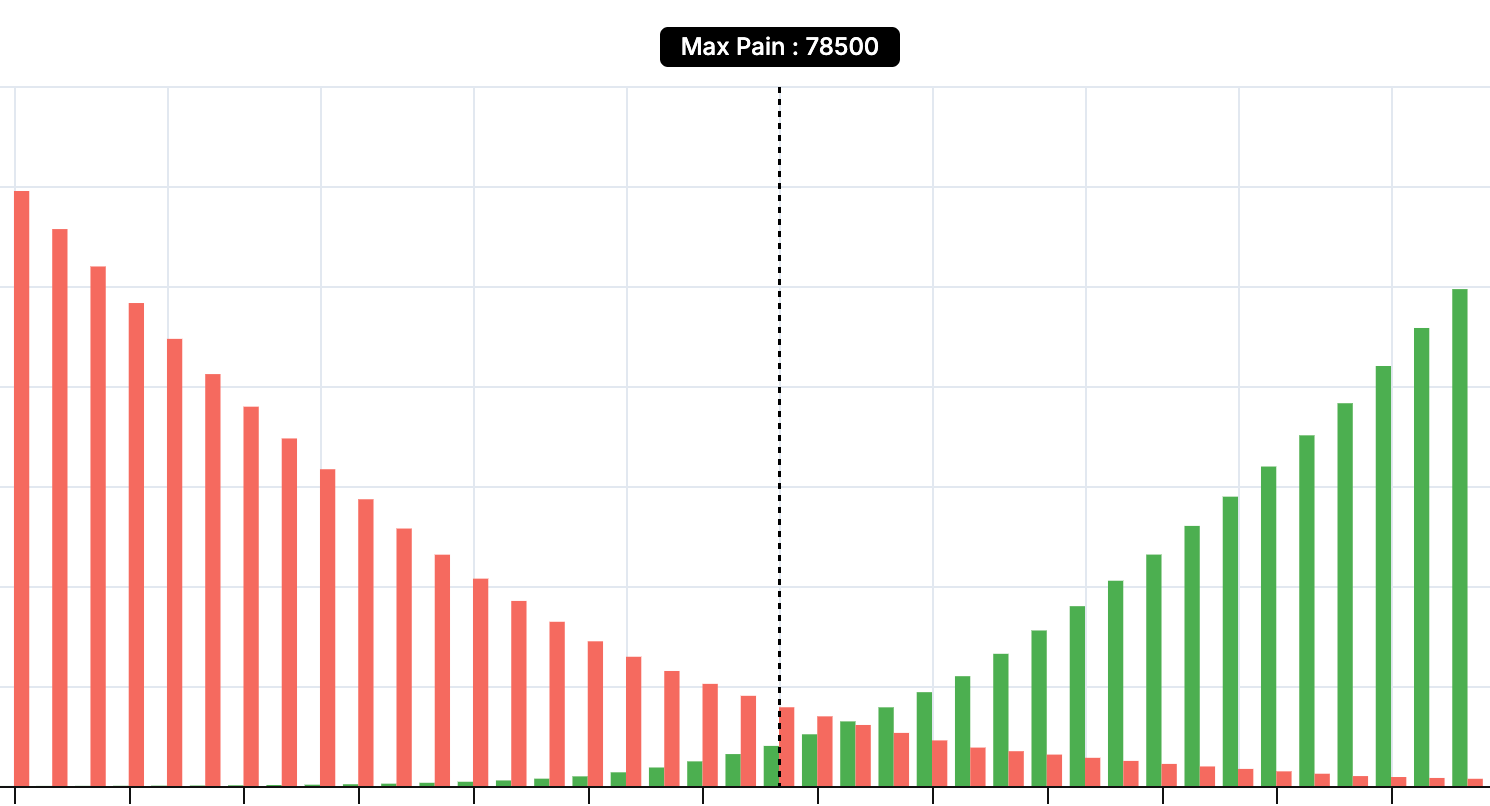
Max Pain for NIFTY is the strike price at which the maximum number of options (both calls and puts) would expire worthless, causing maximum financial loss to option holders and maximum profit to option writers. This level represents the theoretical price where market makers and option writers would prefer the underlying to settle at expiration.
Max Pain for NIFTY is calculated by determining the strike price that would result in the lowest total value of outstanding options at expiration. The calculation involves:
1. Call Pain Calculation: For each strike below the current price, multiply the open interest by the intrinsic value difference
2. Put Pain Calculation: For each strike above the current price, multiply the open interest by the intrinsic value difference
3. Total Pain: Sum of call pain and put pain for each strike price
4. Max Pain Strike: The strike with the minimum total pain value
Our system processes real-time open interest data for NIFTY to provide accurate Max Pain calculations updated every minutes during market hours.
Max Pain is crucial for NIFTY trading because:
• Price Gravitational Effect: NIFTY tends to gravitate toward the Max Pain level as expiration approaches
• Market Maker Influence: Large option writers often have significant influence on underlying price movement
• Risk Management: Helps traders understand where institutional money is positioned
• Expiry Strategy: Critical for weekly and monthly expiry trading strategies
• Sentiment Analysis: When NIFTY trades significantly above or below Max Pain, it indicates strong directional bias
This analysis helps in making informed trading decisions.
When NIFTY price deviates from Max Pain:
Above Max Pain:
• Bullish sentiment - buyers are in control
• Call option writers may face losses
• Market may resist moving higher due to gamma hedging
• Often indicates strong upward momentum
Below Max Pain:
• Bearish sentiment - sellers dominate
• Put option writers may face losses
• Market may resist moving lower due to gamma hedging
• Often indicates strong downward pressure
Near Max Pain:
• Neutral sentiment - balanced market
• High probability of price gravitating toward Max Pain at expiry
• Lower volatility expected
NIFTY Max Pain data is updated with the following frequency:
Historical Mode:
• End-of-day data for selected historical dates
• Complete historical analysis available for backtesting
To get a complete picture of NIFTY options market, use these complementary tools:
Track option open interest changes and build-up patterns for NIFTY
Analyze Put-Call parity and premium differences for NIFTY options
Real-time option chain with Greeks and implied volatility for NIFTY
Monitor PCR trends and market sentiment indicators for NIFTY
Pro Tip: Use Max Pain alongside Open Interest and PCR analysis for comprehensive NIFTY options strategy development.
Max Pain is not a direct price prediction tool, but provides valuable insights for NIFTY:
What Max Pain CAN do:
• Indicate potential support/resistance levels around the Max Pain strike
• Show where option writers prefer NIFTY to settle
• Identify unusual option activity and institutional positioning
• Help time option entries and exits
What Max Pain CANNOT do:
• Predict exact price movements or direction
• Account for sudden news or market events
• Override strong fundamental or technical factors
• Guarantee price will reach Max Pain level
Best Practice: Use Max Pain for NIFTY as one component of a comprehensive analysis including technical analysis, market sentiment, and fundamental factors.
Effective NIFTY options trading strategies using Max Pain:
Strategy 1 - Mean Reversion:
• When NIFTY is far from Max Pain, expect price to move toward the Max Pain strike
• Sell options with strikes away from Max Pain
• Buy options with strikes near Max Pain
Strategy 2 - Expiry Week Trading:
• Monitor how close NIFTY is to Max Pain before expiry
• Adjust positions based on probability of reaching the Max Pain strike
• Use for iron condor and butterfly strategies
Strategy 3 - Risk Management:
• Avoid selling options when NIFTY is very close to Max Pain
• Use Max Pain as a reference for stop-loss levels
• Monitor changes in Max Pain throughout the trading session
Always combine Max Pain analysis with proper risk management and position sizing.
Need more help with options trading strategies?
Nifty 50 (NIFTY) Max Pain on Expiry Day
Why is NIFTY Max Pain most relevant on expiry day?
Expiry day is when the Max Pain pull is typically strongest. Time value collapses to near zero in the final hours, and option writers' hedging activity becomes more concentrated as they manage their books into settlement. Nifty 50 often trades in a tight range around the dominant OI cluster, and that cluster is usually near Max Pain. Many expiry days show clear "pinning" behaviour where NIFTY stays within 30-50 points of Max Pain for extended periods.
How to read the NIFTY Max Pain number on expiry day
Check Max Pain at the opening bell. Compare against spot. If spot is close (within 0.5%), the tool is signalling a pinning day — expect mean-reverting action and avoid directional trades. If spot is 1-1.5% away, a drift is possible but not guaranteed. If spot is more than 2% away, Max Pain is probably not going to be reached in one session — focus on price action instead. The Max Pain number often shifts slightly during the day as OI unwinds, so re-check every 1-2 hours.
Strategies around NIFTY Max Pain on expiry day
Strategy 1: Sell a strangle centered near Max Pain if spot is already close. Collect premium as time decay accelerates. Strategy 2: Trade a directional move toward Max Pain if spot is 1-2% away. Keep stops tight because the pull is weak. Strategy 3: Fade failed moves away from Max Pain — if NIFTY briefly spikes away and then stalls, the reversion is often quick. Strategy 4: Simply avoid trading on expiry day if the setup is unclear. The day's gamma risk is high and poor setups get punished fast.
Risk management on NIFTY expiry day
Expiry day gamma risk is extreme. A small Nifty 50 move can turn profitable positions into losses within minutes. Rule of thumb: risk at most 1-2% of capital per expiry-day trade. Use hard stop-losses and respect them without hesitation. Do not average down on losing positions — the time-decay clock is against you. Do not hold expiring positions into the close unless you are confident about settlement. As of 22 October 2026, the discipline of strict risk management on expiry day is what separates profitable Max Pain traders from those who blow up.
Nifty 50 (NIFTY) Max Pain: Intraday Usage Guide
When does intraday NIFTY Max Pain matter most?
Intraday Max Pain is most useful on expiry day itself. On other days, positions are still being built and Max Pain shifts too much to rely on it for intraday trades. On expiry day, as OI unwinds and options approach settlement, the intraday Max Pain becomes a meaningful reference point. Watching how it moves during the session gives you real-time insight into where Nifty 50 is being pulled.
Opening hour NIFTY Max Pain check
At the market open on expiry day, note the Max Pain value and compare to spot. If spot is within 0.5%, a pinning day is likely. If spot is 1-2% away, prepare for a drift. If it is more than 2% away, expect volatility with no clear Max Pain influence. This opening check takes 30 seconds but sets the tone for your entire session.
Mid-day NIFTY Max Pain monitoring
Check Max Pain again around 11:30 AM and 1:30 PM. Has it shifted? If yes, is the shift aligned with the price action (both moving in the same direction) or against it (divergent)? A Max Pain that rises while Nifty 50 price falls suggests put writers are building fresh support — possibly a bounce is coming. A Max Pain that falls while price rises suggests call writers are building fresh resistance — possibly a stall is coming. Divergences often give early warning of intraday reversals.
Final-hour NIFTY Max Pain action
In the final hour on expiry day (2:30-3:30 PM), the Max Pain pull is at its peak. Watch for Nifty 50 drifting toward the level without much directional conviction. If it reaches Max Pain and stabilises, pinning is confirmed. If it overshoots or pulls away in the final 15 minutes, the pull has failed and other forces are dominant. As of 22 October 2026, the final-hour read is the most important intraday Max Pain observation of the week.
Nifty 50 (NIFTY) Max Pain: Tracking Changes Over the Week
Why track NIFTY Max Pain day by day
Max Pain on Monday is usually different from Max Pain on Thursday. By tracking how it evolves across the Nifty 50 expiry week, you see how institutional positioning is changing. A Max Pain that rises steadily from 22300 on Monday to 22800 on Thursday tells you that put writers have been building conviction all week — bullish. A Max Pain that falls over the week tells you call writers are becoming dominant — bearish. The direction of change matters as much as the current value.
Building a NIFTY Max Pain log
Keep a simple log of NIFTY Max Pain at the end of each session during expiry week. A few columns: date, Max Pain value, spot price, difference (%), and comments. After a few expiry cycles, you will see patterns. For example, you might notice that Nifty 50 Max Pain typically stabilises by Wednesday of the monthly expiry week, and from that point the pull becomes most reliable. These observations become your personal playbook.
Reading the NIFTY shift direction
The direction of Max Pain shifts often leads price action. If Max Pain is rising while NIFTY is flat, the hidden bullish positioning suggests a move higher is likely in the following days. If Max Pain is falling while price is flat, expect pressure to the downside. The leading-indicator nature of Max Pain shifts is one of its most useful properties — a signal that often appears before price confirms it.
Using shifts to anticipate NIFTY settlement
In the last 2-3 sessions, the rate of Max Pain change slows significantly. If it keeps shifting rapidly right into the final hours, the expiry is still being contested and pinning is unlikely. If it stabilises early, pinning becomes more probable. As of 22 October 2026, this simple observation about Max Pain stability is a reliable filter for whether to take mean-reversion trades on Nifty 50 expiry day.
About the Max Pain Calculator
Max pain is the strike price at which the largest rupee value of option contracts would expire worthless. Simple idea, important consequences. Option writers in India are overwhelmingly institutional, and the delta hedging they do to stay risk-neutral tends to nudge the underlying toward the strike where the most contracts expire worthless. Not manipulation, just mechanics. On weekly Nifty expiries the gravitational pull toward max pain strengthens sharply by Thursday morning.
Nifty weekly options expire every Thursday. Empirical work on NSE data suggests that Nifty settles within 0.5-1% of max pain on roughly 35-45% of weekly expiries when there's no major news in the week. The accuracy goes up when max pain lines up with OI concentration. If max pain reads 22,400 and the highest Call OI and Put OI both sit near 22,400, the probability of a 22,400 close rises noticeably.
How max pain is calculated
For every active strike, compute the loss call holders would take if the underlying expired at that strike, then the loss put holders would take. Sum both. Repeat for every strike in the chain. The strike with the highest total loss is max pain. In formula terms, for a hypothetical expiry price S: total pain = Σ(Call OI × max(0, S − strike)) + Σ(Put OI × max(0, strike − S)). The max pain strike is the S that maximises this total.
A worked example. Say Nifty shows three notable OI concentrations: 22,200 PE with 1 crore OI, 22,400 CE with 80 lakh, 22,400 PE with 70 lakh. If Nifty settles at 22,400, the 22,400 CE and the 22,400 PE both expire worthless, and the 22,200 PE holders lose the full premium too. 22,400 reads as a strong max pain candidate. Our calculator runs this across every active strike and updates live as OI shifts through the session.
Using max pain on Nifty and BankNifty
Treat it as a reference level, not a target. If Nifty is 22,600 early in the week and max pain reads 22,400, a mean-reversion trader might expect gradual drift lower into Thursday. Same logic in reverse for Nifty below max pain. Straddle and strangle sellers typically center positions near the max pain strike because that's where premium erosion is maximised.
Max pain is dynamic. Fresh writes and unwinds through the week can shift the strike materially. A 22,400 reading on Monday can easily move to 22,500 by Wednesday if heavy put writing shows up at 22,500. Watch the drift. For a fuller picture, pair the max pain chart with our Open Interest Analysis and Put Call Ratio.
Limitations
Max pain works best in range-bound or gently trending markets. Event days (RBI policy, budget, global shocks) can blow past it by several hundred points. BankNifty, being more volatile than Nifty, deviates more often. So don't trade max pain on its own. Read it next to PCR, IV levels and institutional OI, and let those decide whether the magnet is worth trusting that week.
Distance from max pain: quick reference
| Spot vs max pain strike | Typical expiry-week behaviour | Practical read |
|---|---|---|
| Within 0.5% | Pinning zone, where spot often stays glued to the strike into expiry | Premium selling around the strike is favoured; expect low drift |
| 0.5% to 2% | Gravitational drift toward the strike is common in quiet weeks | Directional bias points toward the max pain level |
| 2% to 3% | The pull weakens; price action and OI walls matter more | Treat max pain as context, not a target |
| Above 3% | A trend or event is in control and max pain stops mattering | Trade the trend; ignore the magnet until the gap narrows |
These bands are tendencies from NSE expiry weeks, not guarantees. Event weeks (RBI policy, budget, results) routinely override the pull. The calculator above recomputes the live max pain strike every minute during market hours.
How to use the StockMojo Max Pain tool
- Select an index or stock — Pick Nifty, BankNifty, FinNifty, or any F&O stock from the symbol selector at the top of the tool.
- Choose an expiry — Select the expiry you want to analyze: current week, next week, or monthly. The tool defaults to the nearest expiry.
- Read the highlighted max pain strike — The strike with the lowest total writer loss is highlighted. This is the level where option buyers as a group lose the most.
- Compare with current spot price — Look at the difference between max pain and the live underlying price. A large gap creates a stronger 'magnet' setup as expiry approaches.
- Cross-check with PCR and OI buildup — Open the Put Call Ratio and Open Interest tools alongside max pain. Use them together to confirm directional bias before placing a trade.
Frequently Asked Questions
What is max pain in options trading?
Max pain is the strike price at which the maximum number of options (calls and puts combined) would expire worthless, causing the greatest aggregate financial loss to option buyers. It's calculated by summing the rupee value of all in-the-money options at every strike for an upcoming expiry and identifying the strike with the smallest total. The theory holds that markets often gravitate toward this level in the final sessions before expiry.
How is Nifty max pain calculated?
For each strike in the Nifty option chain, the StockMojo tool computes how much money option writers would lose if Nifty closed at that strike on expiry. It adds up the intrinsic value of all in-the-money calls and puts at every other strike, weighted by their open interest. The strike with the lowest total loss to writers (and highest total loss to buyers) is the max pain level. The calculation runs live on the latest OI snapshot from NSE.
Why does the market often gravitate toward the max pain strike at expiry?
Because option writers (typically large institutions and proprietary desks) have a strong financial incentive to defend the max pain strike. As expiry approaches and gamma increases, hedging activity by writers tends to push the underlying back toward the strike where their aggregate payout is smallest. You'll see this most clearly in the final two sessions of weekly expiries.
How accurate is max pain as an expiry predictor?
Max pain is directionally useful but not a precise prediction. Studies on Nifty and BankNifty show the index closes within 1% of the max pain strike on roughly 60-70% of weekly expiries. That's meaningfully better than random, but still unreliable as a standalone signal. It's most powerful when combined with PCR, smart OI, and price action confirmation.
How often does max pain change during the day?
Max pain recalculates every time underlying OI shifts. On a typical Nifty day, the max pain strike can move 50-150 points intraday as positions are added and unwound. StockMojo refreshes the live max pain reading on the same cadence as the option chain feed, so traders always see the current level.
Max pain vs Put Call Ratio: which gives better directional bias?
They answer different questions. Max pain tells you the price level where option writers profit most, while PCR reads the directional sentiment of put vs call writers. In practice, max pain earns its keep in the last 2-3 days before expiry as a magnet level. PCR does more work intraday as a sentiment gauge. Most experienced traders run both together, taking direction from PCR and the target level from max pain.
How should intraday traders use max pain?
Intraday traders use max pain as a gravitational reference. When the index drifts well above the strike, mean-reversion shorts have an edge, and a drift well below gives the same edge to mean-reversion longs. The signal strengthens as expiry day approaches and weakens earlier in the week. Always confirm with current OI buildup before acting.
What are the limitations of max pain analysis?
Max pain is a snapshot of writer positioning, not a forecast. It can shift sharply on a single large order, it ignores futures and stock-side hedges, and it has limited signal value in the first half of the expiry week. Major news events override it entirely. Treat it as one input among several, not a standalone trading rule.
Learn more
Read our guide: Max Pain Theory Explained: The Max Pain Option Level