Live NSE Option Chain 2026 — Nifty, BankNifty, Sensex & F&O Stocks with OI, IV, Greeks
Nifty 50 (NIFTY) Option Chain: Greeks — Delta, Theta, Gamma, Vega
What is Delta in the NIFTY option chain?
Delta measures how much the NIFTY option premium changes when the underlying moves by 1 point. In the NIFTY chain, Delta ranges from 0 to 1 for calls and 0 to -1 for puts. ATM options have Delta near 0.5 — a 1-point NIFTY move changes the premium by about 0.50. Deep ITM options have Delta near 1.0 (moving point-for-point). Far OTM options have Delta near 0 (barely reacting). Use Delta to choose strikes: high-conviction traders pick high-Delta ITM options. Budget-conscious traders pick low-Delta OTM.
What is Theta and how it affects NIFTY option prices daily
Theta is the daily time decay — how much premium the NIFTY option loses each day just from time passing. In the option chain, ATM strikes show the highest Theta because they have the most time value to lose. Theta is always negative for option buyers (you lose money daily) and positive for sellers (you earn money daily). For Nifty 50 options, Theta accelerates in the last 5 days before expiry — the final week accounts for roughly half of total decay. If Theta at your NIFTY strike shows -5, your option loses approximately Rs. 5 per share per day. This is why timing matters enormously for option buyers.
What Gamma reveals about NIFTY options near expiry
Gamma measures how fast Delta changes as NIFTY moves. It is highest for ATM options near expiry. In the NIFTY chain, high Gamma strikes are the most reactive — small underlying moves cause large premium swings. On expiry day, Gamma at ATM NIFTY options can be extremely high. This means a 50-point move could turn a Rs. 5 option into Rs. 50, or vice versa. For sellers, high Gamma is dangerous — the risk of sudden loss spikes. For buyers, it is an opportunity for outsized returns with small capital. Always check Gamma in the NIFTY chain before trading near-expiry options.
How Vega in the NIFTY chain helps you trade volatility
Vega tells you how much premium changes for a 1% change in IV. In the NIFTY option chain, ATM options typically have the highest Vega. If Vega is 10 and IV rises by 2%, the premium increases by Rs. 20 — regardless of what NIFTY price does. Before major events (budget, RBI policy, elections), IV rises and Vega works in favour of option holders. After events, IV crushes and Vega works against them. The NIFTY chain shows both IV and Vega at every strike — use Vega to estimate how much a potential IV change will affect your position's value.
How to Analyse Nifty 50 (NIFTY) Option Chain for Intraday Trading
Pre-market preparation using the NIFTY option chain
Before the market opens, check the NIFTY option chain's previous close data. Identify the top 3 call OI strikes (resistance) and top 3 put OI strikes (support). Note the PCR — above 1.0 is bullish bias, below 0.8 is bearish. Check max pain — where is the gravitational pull for expiry? This 2-minute review gives you a framework for the entire Nifty 50 session. Most traders skip this and spend the day reacting to random price ticks. For index options, pre-market OI levels are especially reliable because of institutional participation.
Reading the first 15 minutes in the NIFTY chain
The opening 15 minutes of the NIFTY option chain are the most information-rich of the day. Watch which strikes show the biggest OI Change — these are institutional orders setting the day's tone. Heavy put writing (Short Buildup at put strikes with rising OI) in the first 15 minutes is bullish — institutions are placing a floor under Nifty 50. Heavy call writing is bearish — they are placing a ceiling. The Buildup column makes this easy to read. If both sides see balanced writing, expect a range-bound session.
Tracking key levels throughout the NIFTY session
During the session, the NIFTY option chain tells you when key levels are under pressure. Watch the OI Change at the highest put OI strike — if it turns negative (OI declining), support is crumbling. Watch the highest call OI strike — if OI drops there, resistance is breaking. These OI Change signals often precede the actual price breakout by 5-15 minutes, giving you an early entry. Also monitor the PCR column — a steadily rising PCR through the day confirms bullish sentiment. Falling PCR confirms bearish pressure on Nifty 50.
End-of-day signals in the NIFTY option chain
The last hour (2:30-3:30 PM) is when institutions make their final positioning decisions for Nifty 50. OI Change during this period is highly predictive for the next session. If fresh put writing appears in the last hour, institutions are bullish overnight. Fresh call writing means caution. The Buildup column during the final hour reveals the smart money's view. Also check if max pain shifted during the day — a moving max pain means the market is repositioning for expiry. End-of-day NIFTY option chain analysis takes 5 minutes and can save you from being on the wrong side of an overnight gap.
Nifty 50 (NIFTY) Option Chain: Strategies Based on OI and IV Data
Straddle and Strangle using NIFTY OI levels
The NIFTY option chain's OI data naturally defines the parameters for straddle and strangle strategies. For a short strangle: sell the call at the highest call OI strike (resistance) and the put at the highest put OI strike (support). The OI-backed levels give your sold strikes a higher probability of being defended. For straddles: sell at the ATM strike when the Buildup column shows balanced activity (not strongly directional). Each lot of a strangle on NIFTY collects premium from both the call and put sale — the IV column tells you whether the premium collected is rich (high IV) or thin (low IV).
Iron condor construction from the NIFTY chain
An iron condor sells an OTM call spread and OTM put spread. The NIFTY option chain guides construction perfectly. Sell the call at the highest call OI (resistance). Sell the put at the highest put OI (support). Buy protection one or two strikes beyond each sold leg. The NIFTY chain shows the premium at each leg, so you can calculate net credit, max loss, and breakeven before entering. Check that the sold strikes have adequate Volume for clean entry. The Buildup column should not show Long Buildup at your sold strikes — that would mean buyers are active there, which works against short positions.
When to buy options based on NIFTY IV data
The NIFTY option chain's IV column tells you when buying is attractive. If IV is in the lower quarter of its recent range, premiums are cheap — this is the optimal time to buy calls or puts on Nifty 50. Look for strikes where Buildup shows Long Buildup (fresh buyers entering) combined with low IV. This combination means you are buying cheaply alongside informed participants. For Nifty 50, IV typically bottoms during calm periods between events — budget, RBI policy, earnings.
When to sell options based on NIFTY IV data
Sell NIFTY options when IV is elevated — the chain's IV column shows this clearly. High IV means premiums are inflated and likely to contract. Selling during high IV captures the volatility premium that decays over time. The ideal selling setup in the Nifty 50 chain: high IV + Short Buildup at your target strike + high OI already present at that level. This means the option is expensive (high IV), sellers are active (Short Buildup), and the level is being defended (high OI). For Nifty 50, IV peaks before major events — sell strategies initiated just before the event often benefit from post-event IV crush.
About the NSE Option Chain
Free real-time and historical option chain with OI, volume, Greeks, and IV for Nifty 50, BankNifty, Sensex, and 200+ F&O stocks. Updates every second in live mode. Switch to Historical Mode to replay past option chain data for any trading date and back-test your strategies on actual minute-level state.
Open Interest in the chain
Open Interest is the total count of outstanding option contracts that haven't been closed, exercised, or expired. In the NSE chain, every strike has separate OI figures for calls and puts. When a new buyer and a new seller enter a contract, OI rises by one lot. When an existing buyer sells to an existing seller, OI drops by one lot. The distinction matters: rising OI is fresh money entering, falling OI is positions getting squared off.
Nifty 50 strikes are spaced 50 points apart (22,000, 22,050, 22,100). BankNifty uses 100-point intervals. Weekly expiries are every Thursday, monthlies on the last Thursday of the calendar month. Heavy Call OI at 22,500 implies option sellers believe Nifty is unlikely to cross that level before expiry, making it resistance. Heavy Put OI at 22,000 implies sellers expect support there.
Reading the Greeks
Greeks quantify how option price reacts to various factors. The chain displays four for every strike. Delta measures how much premium changes for a one-point underlying move. An ATM Nifty call typically has Delta around 0.50, so premium rises by ~0.50 rupees per one-point Nifty rise. Deep ITM calls approach 1.0, far OTM calls approach 0. Gamma measures rate of change of Delta. High Gamma near ATM means Delta shifts rapidly, which raises risk for option sellers.
Theta is time decay. An ATM Nifty weekly option with three days to expiry might have Theta of -8 to -12, meaning premium loses 8-12 rupees per day from time alone. Vega measures sensitivity to IV: a one-point rise in IV might add 5-15 rupees to an ATM premium depending on time to expiry. Watching Greeks alongside OI tells you not just where positions are concentrated but how they'll react to different scenarios.
Why Historical Mode matters
Load the chain as it appeared on any past trading date. Invaluable for back-testing. Examine the chain on a budget day or RBI policy morning and watch how OI, IV, and premiums evolved through the session. If you're developing a short straddle strategy, check how ATM premiums behaved on past weekly expiry days to estimate realistic targets and drawdowns. Historical data also validates your read of OI-based support and resistance. If Put OI was concentrated at 22,000 on Tuesday, fast-forward to Thursday's expiry and see whether 22,000 actually held.
Using the chain for Nifty and BankNifty trading
Professional traders start the day by scanning the chain for the highest OI strikes on both sides. These define the expected range. If the top Call OI is at 22,500 and top Put OI is at 22,000, the implied range is 22,000-22,500. A breakout above 22,500 with rising Call OI unwinding signals a bullish shift. A breakdown below 22,000 with Put OI declining signals bearish momentum. Same logic applies on BankNifty, just with wider expected moves due to higher volatility. Volume data complements OI: high OI with low volume is holding steady; high volume with OI increase signals fresh aggressive positioning.
Pair the option chain with our Open Interest Analysis, Max Pain Calculator, and Multi-Strike OI for fuller research.
Option Chain: Video Walkthrough
How to use the StockMojo Option Chain
- Pick a symbol — Type or select Nifty, BankNifty, FinNifty, or any F&O stock in the symbol search at the top.
- Choose your expiry — Use the expiry dropdown to switch between weekly and monthly contracts. The current week is selected by default.
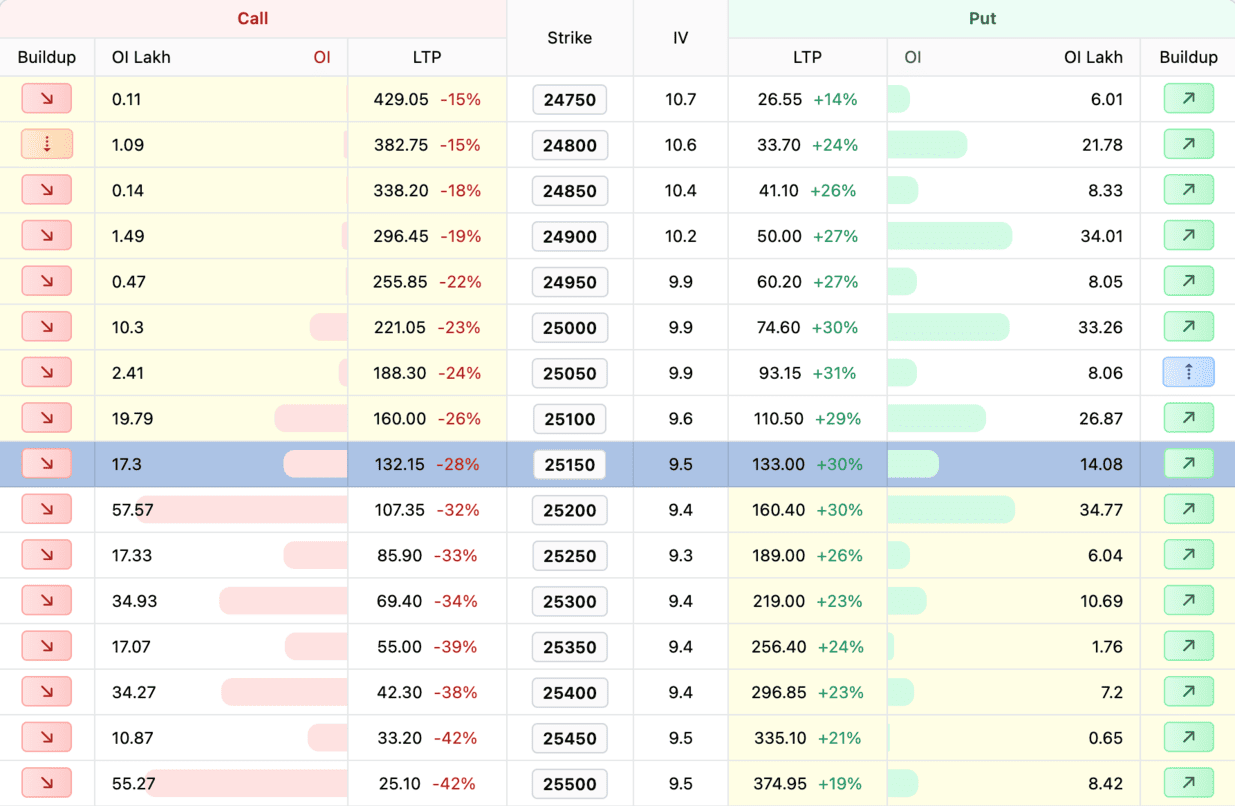
- Identify the ATM strike — Find the highlighted at-the-money strike — this is your reference point for reading OI and IV across the chain.
- Scan OI and Change in OI — Look for strikes with the highest call OI (resistance) and put OI (support). Check Change in OI to see where new positions are being built right now.
- Cross-reference with Max Pain and PCR tools — Open Max Pain and Put Call Ratio in adjacent tabs to confirm whether the OI picture aligns with broader sentiment.
Frequently Asked Questions
What is an option chain and how do you read it?
An option chain is a tabular listing of every available call and put for a given underlying, organized by strike price and expiry. Each row shows the strike; calls are typically displayed on the left, puts on the right. Key columns include last traded price (LTP), bid/ask, volume, open interest, change in OI, and the option Greeks. Reading it well is the foundation of every options strategy.
What columns matter most in the StockMojo option chain?
The most actionable columns are Open Interest (where positions are concentrated), Change in OI (where new positions are being built or unwound), Implied Volatility (how expensive each strike is), and Delta (directional exposure). Volume helps confirm whether OI changes are real activity or stale positions. The StockMojo chain highlights ITM strikes and ATM strikes for quick visual scanning.
How are Greeks (Delta, Gamma, Theta, Vega) calculated in real time?
Greeks are computed from the Black-Scholes model using the live underlying price, the option's strike, time to expiry, current implied volatility, and the prevailing risk-free rate. StockMojo recalculates them every tick from the live NSE feed so the displayed values match real-time market conditions, not delayed snapshots.
What does open interest in the option chain tell traders?
OI shows where market participants have committed capital. A strike with very high call OI typically acts as resistance — it represents the largest concentration of call writers defending that level. The same logic applies to puts as support. Combined with change in OI, this is the single most-used signal in Indian options trading.
How is implied volatility shown in the option chain?
IV is displayed per strike, per option type. A symmetric IV across calls and puts at the same strike indicates a neutral market; a skew (puts more expensive than calls) indicates downside hedging demand. Watching IV across strikes reveals the volatility smile — a fundamental input for premium-selling strategies.
What's the difference between live and historical option chain views?
The live view shows real-time NSE data refreshed every few seconds during market hours. The historical view (Timeseries Option Chain) lets traders replay past option chain snapshots — useful for studying how OI shifted around past events, expiries, or news. Both views share the same column layout.
How often does the option chain update?
During market hours (09:15-15:40 IST), the StockMojo option chain updates on every NSE tick, typically every 1-3 seconds depending on activity. Greeks and IV are recalculated on each refresh. Outside market hours the chain shows the closing snapshot.
What expiries are available for Nifty, BankNifty, and stocks?
Nifty has weekly expiries every Thursday plus a monthly expiry on the last Thursday. BankNifty currently has a monthly expiry on the last Wednesday after the discontinuation of weekly contracts. F&O stocks have monthly expiries on the last Thursday. All available expiries appear in the StockMojo expiry selector for the chosen symbol.
How do you analyse the Nifty option chain for intraday trading?
Start from the ATM strike and find the largest call OI above spot and the largest put OI below it — that is the market's expected intraday range. Then watch Change in OI: fresh call writing at a strike pushes resistance toward it, fresh put writing lifts support. Confirm with volume so you're reading live activity rather than stale positions, and check IV to judge whether premiums favour buying or selling. A break beyond the highest-OI strike accompanied by that side's OI unwinding is the classic intraday breakout signal.