BANKNIFTY Futures Intraday Chart today | Live NSE F&O Data
Analyze BANKNIFTY futures intraday movements with StockMojo's real-time charting tool. Track live price action, open interest (OI) shifts, and volume spikes on a minute-by-minute basis to stay ahead of market trends.
Our BANKNIFTY futures terminal provides a comprehensive view of derivative market activity. Monitor institutional positioning and retail participation through high-frequency OI updates. Identify key intra-day levels where buying or selling pressure is building up. Whether you are scalping or swing trading, having access to live BANKNIFTY future data combined with historical context is essential for managing risk and optimizing entry/exit points.
Complement your intraday research with our Open Interest Analysis,Price vs OI Divergence, and Smart OI tools.
Bank Nifty (BANKNIFTY) Future Intraday: Expiry Day Trading
Why expiry day is different for BANKNIFTY futures
On expiry day, Bank Nifty futures converge toward spot as the contract nears settlement. Basis narrows to zero. Volatility can be elevated due to options-related hedging. The tool shows these unique dynamics, making expiry day trading both more profitable and more dangerous.
Reading expiry day OI on BANKNIFTY
Futures OI typically declines on expiry day as positions close or roll to the next month. Rapid OI decline is normal. What matters is the direction of price during the unwind. Rising price with declining OI suggests long covering (bulls exiting). Falling price with declining OI suggests short covering (bears exiting).
Rollover dynamics on BANKNIFTY
Many traders roll their positions from the current month to the next in the final 2-3 sessions before expiry. The tool shows this through declining OI in the front month and rising OI in the next. Watching rollover activity tells you how conviction is shifting across expiries on Bank Nifty.
Expiry day strategies as of 13 October 2026
Conservative approach: close positions before expiry and re-establish in the next month. Aggressive approach: trade the expiry-day volatility with small size and tight stops. Both have merit. Choose based on your experience and risk tolerance. Never hold a losing position into expiry hoping for a reversal.
Bank Nifty (BANKNIFTY) Future Intraday: Daily Routine
Pre-market BANKNIFTY check
Before the market opens, review yesterday's closing futures price and OI for Bank Nifty. Check overnight global markets. Check for any scheduled events today. Note key technical levels on the chart. This 5-minute preparation sets your trading framework for the session.
Opening hour monitoring on BANKNIFTY
Watch the first 60 minutes closely. Observe how futures price, volume, and OI behave. Identify the day's likely direction based on opening patterns. Take high-conviction trades during this window when signals are strongest.
Mid-session management on BANKNIFTY
During the quiet 11 AM - 1:30 PM period, manage open positions rather than opening new ones. Check stops, take profits where appropriate, and plan for the afternoon. Use the lull productively for analysis and preparation.
Closing hour action on BANKNIFTY as of 13 October 2026
The final hour (2:30-3:30 PM) brings fresh opportunities. Watch for breakouts with volume and OI confirmation. Make decisions about overnight positions. End the day with notes on what happened and what you learned. Journaling daily compounds skill over months.
Bank Nifty (BANKNIFTY) Future Intraday: Opening Hour Strategy
Why opening hour matters on BANKNIFTY
The first 30-60 minutes of Bank Nifty futures trading often sets the tone for the entire session. Overnight orders hit the market. Institutional positioning happens. The volume and OI patterns established in this window typically persist through the day.
Opening pattern recognition on BANKNIFTY
Watch how futures price, volume, and OI behave in the first 15 minutes. A strong upward move with rising OI signals a trending bullish day. A sharp drop with rising OI signals bearish pressure. Balanced movement with modest OI changes signals a range-bound day.
Trading the opening on BANKNIFTY
For aggressive traders, the opening hour offers the fastest opportunities. For conservative traders, observe the opening and trade only after the pattern is clear (usually by 10:00-10:30 AM). Either approach works — match it to your risk tolerance and experience level.
Avoiding opening traps on BANKNIFTY as of 13 October 2026
The opening can be volatile with many false starts. If you enter in the first 15 minutes, use tight stops. If you are uncertain, wait for the pattern to clarify. Respecting the chaos of the opening prevents many losses. Over time you learn which opening patterns are reliable versus traps.
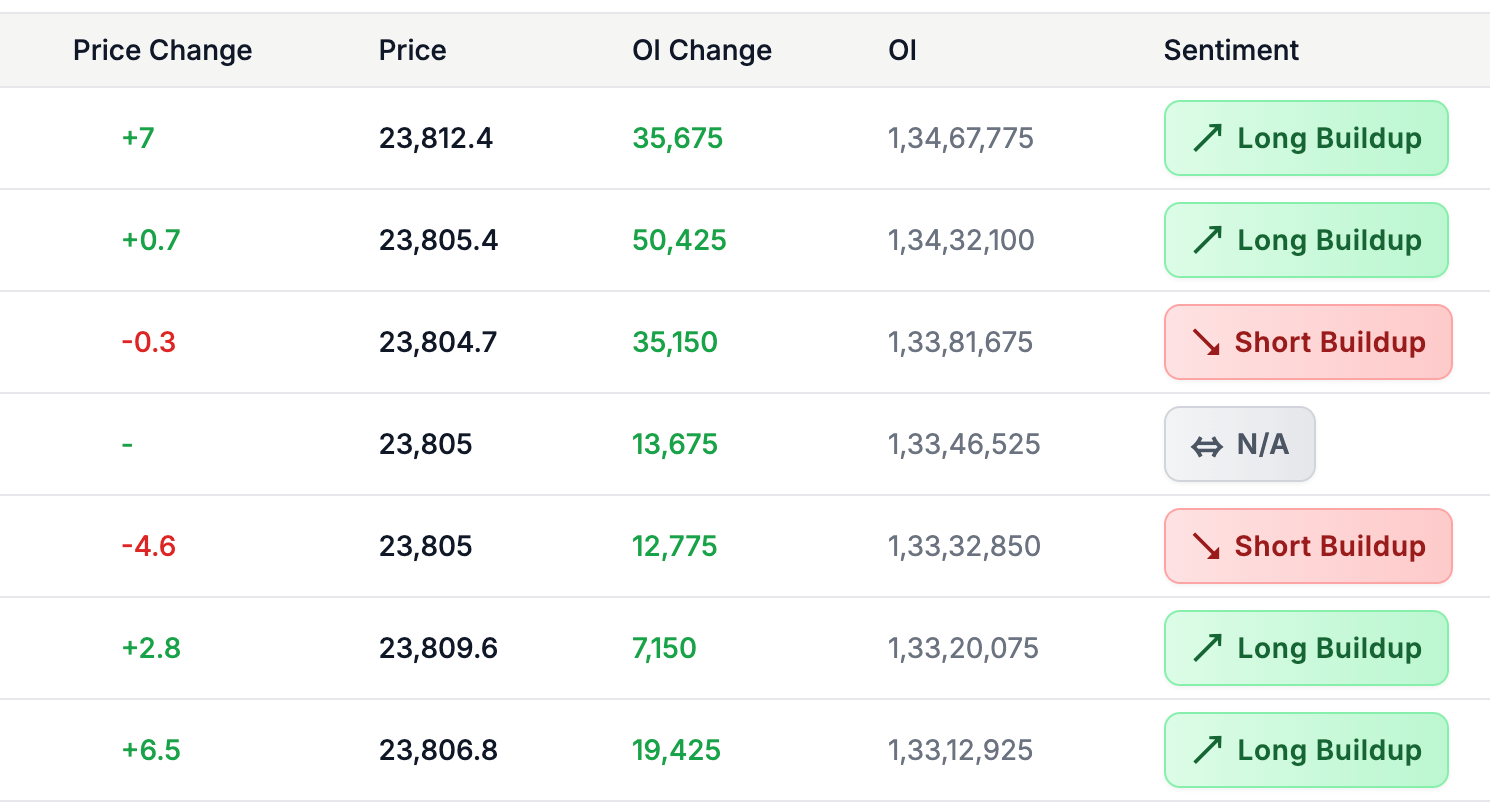
BANKNIFTY futures price vs OI: quick reference
| Price | Open interest | Regime | Common reading |
|---|---|---|---|
| Rising | Rising | Long buildup | Fresh longs entering; strongest bullish signal on BANKNIFTY |
| Falling | Rising | Short buildup | Fresh shorts entering; strongest bearish signal |
| Rising | Falling | Short covering | Shorts exiting; weaker rally that often stalls once covering ends |
| Falling | Falling | Long unwinding | Longs exiting without new sellers; weaker bearish signal |
| Flat | Rising | Accumulation | Positions building ahead of a move; watch for the breakout direction |
These four price-OI regimes are the standard NSE futures read: rising-OI moves carry fresh institutional commitment, falling-OI moves are position exits and fade more often. The live BANKNIFTY table above classifies every 3, 5, or 15-minute interval into one of these regimes, so you can see which side is committing money in real time.
How to use the Future Intraday Chart
- Pick the symbol — Choose Nifty, BankNifty, or any F&O stock. Index futures are the default for most intraday traders.
- Pick the contract month — Near-month is where the volume lives. Switch to next-month if you're studying rollover behaviour around expiry week.
- Read the price and OI lines together — Identify the regime: long buildup, short buildup, short covering, or long unwinding. The colour coding above the chart names it for you.
- Mark the opening-hour reading — Whatever positioning prints between 9:15 and 10:30 IST often dictates the day's bias. Note it.
- Watch the final hour — The 2:30 to 3:30 IST window reveals whether positions are being held overnight or unwound. Carry-forward longs are bullish; aggressive late-day unwinds usually aren't.
BANKNIFTY Futures Intraday — Frequently Asked Questions
How to track BANKNIFTY futures intraday?
Track BANKNIFTY futures intraday by watching the live futures price and open interest together, minute by minute. Rising price with rising OI signals long buildup (bullish conviction); rising price with falling OI signals short covering (a weaker move). StockMojo's chart plots both through the NSE session and classifies each interval automatically.
What is BANKNIFTY futures OI analysis?
BANKNIFTY futures OI is the total count of outstanding futures positions on NSE. Increasing OI means fresh money entering and confirms trend strength; decreasing OI suggests profit booking or position unwinding, so the move lacks fresh commitment. Intraday OI change read against price direction is the fastest gauge of whether institutions back the current BANKNIFTY move.
What is long buildup vs short covering in BANKNIFTY futures?
Long buildup means BANKNIFTY futures price and open interest rise together — fresh longs entering with conviction, the strongest bullish regime. Short covering means price rises while OI falls — existing shorts exiting, a weaker rally that often fades once the covering ends. The chart labels every interval with its regime so you can tell new money from squeezed shorts.
How often does the BANKNIFTY futures intraday chart update?
During NSE market hours (9:15 AM to 3:40 PM IST) the BANKNIFTY futures intraday table refreshes every minute with the latest futures price and open interest, and you can aggregate rows into 3, 5, or 15-minute intervals. Outside market hours it shows the last traded session, and historical mode replays any past BANKNIFTY session.
Which BANKNIFTY futures expiry should I track intraday?
Track the near-month BANKNIFTY futures contract — it carries the bulk of volume and open interest, so its intraday OI shifts best reflect institutional positioning. In the final week before expiry, also watch the next-month contract: rollover moves OI into it, and falling near-month OI during rollover is routine squaring-off, not genuine unwinding.
Learn more
Read our guide: Long Buildup vs Short Buildup: Reading OI Change with Price