BANKNIFTY Premium Decay Analysis (Live)
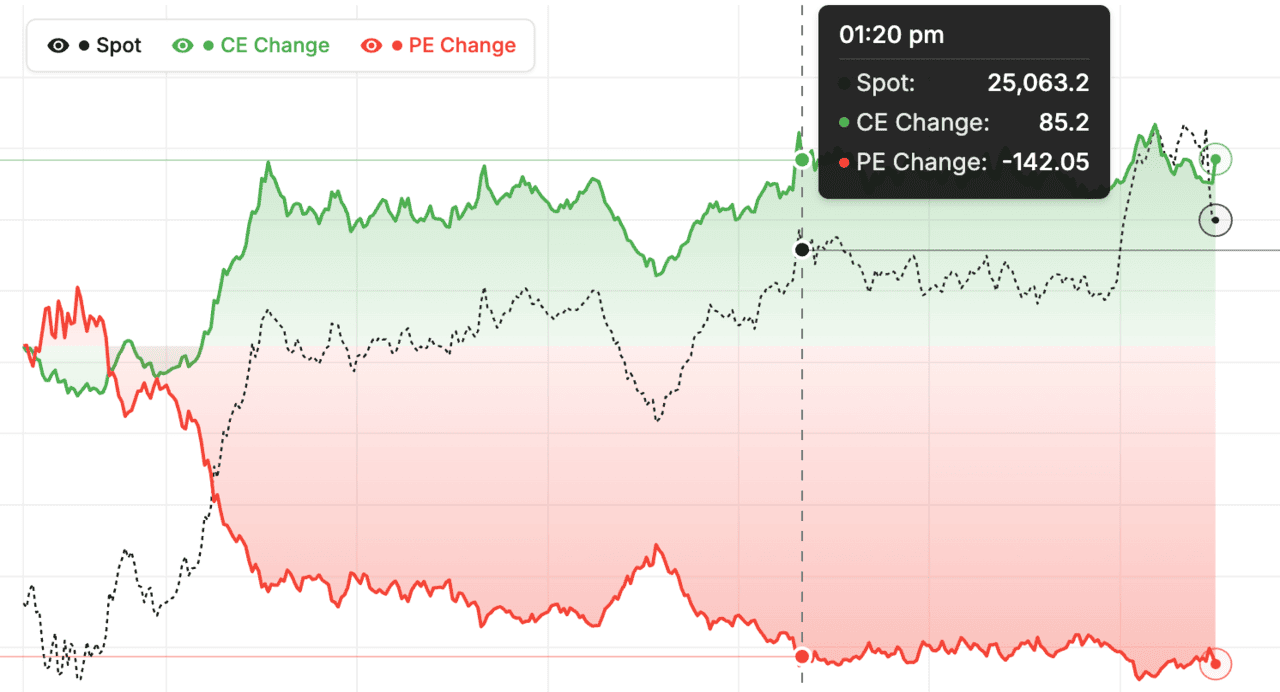
Track real-time premium decay (theta decay) for BANKNIFTY options. Premium decay is the erosion of an option's extrinsic value purely from the passage of time, and it drives the daily loss that BANKNIFTY option buyers pay and option sellers collect. The chart plots Call and Put premium minute by minute so you can watch the decay slope steepen as expiry approaches.
Decay is non-linear: a far-dated BANKNIFTY option loses very little per day, but the same option loses several times more per day in its final week and can shed the bulk of its remaining premium on expiry day. Sellers harvest this theta with short straddles, strangles, and credit spreads; buyers must overcome it with a quick, large directional move in BANKNIFTY. Historical mode lets you replay the decay curve for any past BANKNIFTY expiry to study how premium behaved around results, RBI policy, or major global events.
Pair premium decay with the Straddle Chart for the combined call-plus-put expected move, the IV Chart to see the volatility component that inflates or crushes premium beyond pure theta, and the Option Chain for live per-strike Greeks including theta.
Bank Nifty (BANKNIFTY) Premium Decay: Intraday Decay Patterns
Does BANKNIFTY premium decay intraday?
Yes. Even within a single trading day, Bank Nifty option premium erodes as hours pass. The effect is small on early-cycle days but significant on expiry day itself. On expiry day, a morning premium can lose 50%+ of its value by afternoon even if price stays unchanged. The intraday decay chart visualises this erosion.
Morning vs afternoon decay on BANKNIFTY
Decay is not uniform throughout the day. Mornings often show slight premium inflation as traders position for the day. Mid-day is usually quiet and decay is modest. Afternoons, especially the last 2 hours, show accelerated decay as expiry approaches. The pattern is most obvious on expiry day.
Expiry day intraday decay on BANKNIFTY
On expiry day, decay happens minute by minute. ATM options can lose 70-90% of their morning value by the 3:30 PM close. Short strangles centered near Bank Nifty max pain capture this decay reliably if direction stays in range. The risk is large — gamma is extreme — but theta captures can be significant.
Using intraday decay on BANKNIFTY as of 13 October 2026
For expiry day premium selling, enter early in the morning and watch the decay chart throughout the day. If direction stays favourable, hold into the afternoon for maximum capture. If BANKNIFTY threatens your sold strikes, exit immediately — gamma risk turns winning trades into losers fast on expiry day.
Bank Nifty (BANKNIFTY) Premium Decay: Decay Curves and Strike Selection
What does the BANKNIFTY decay curve show?
The decay curve is the shape of how premium loses value over time at a specific strike. For ATM strikes, the curve is nearly exponential — slow early, steep late. For OTM strikes, the curve can be more linear or even bumpy depending on gamma and delta changes. Understanding curve shapes helps you pick strikes that match your trade duration.
Short-duration trades on BANKNIFTY
For trades held 1-3 days, you want strikes with flat early decay — deep OTM or deep ITM. Your short holding period avoids the steepest part of the decay curve. ATM is usually wrong for short-duration trades because decay is already too fast.
Medium-duration trades on BANKNIFTY
For 1-2 week trades, slightly OTM strikes work well. Decay is noticeable but not extreme. You have time for direction to play out while still benefiting from theta. Most spread strategies use this middle range of strikes.
Long-duration trades on BANKNIFTY as of 13 October 2026
For 3-4 week holds, ITM strikes are often best. Intrinsic value is decay-resistant. Your position holds value even if direction takes time to develop. Look for strikes 2-3% ITM where delta is 0.65-0.75. The decay chart confirms these strikes are losing less per day than ATM alternatives.
Bank Nifty (BANKNIFTY) Premium Decay: Theta Harvesting Strategies
What is theta harvesting on BANKNIFTY?
Theta harvesting is a systematic approach of selling premium to collect time decay income. The goal is consistent small profits from each trade rather than big wins. For Bank Nifty, theta harvesting through iron condors and covered calls is a popular approach among swing traders.
Monthly theta harvest routine on BANKNIFTY
Each month, open new iron condors on BANKNIFTY around the middle of the cycle (10-15 days to expiry). Pick strikes about 1 standard deviation away from spot. Aim for 50-70% of maximum profit, then close. Repeat the cycle. Over 12 months, the consistent income adds up.
Weekly theta harvest routine on BANKNIFTY
For weekly expiries, the cycle is faster. Open positions on Monday or Tuesday with 3-5 days remaining. Close by Thursday morning with profit target. Weekly harvests require more active management but can generate more frequent returns.
Scaling theta harvesting on BANKNIFTY as of 13 October 2026
Start with small size until you have 30-60 days of experience. Then scale gradually as your track record confirms the approach. Never scale after a few winning trades — wait for meaningful sample sizes. Disciplined scaling prevents blowups and builds sustainable returns over time.
Premium Decay & Theta Analysis - NIFTY
Expert insights into NIFTY option price erosion, time value decay, and trading strategies • Real-time Data
Premium decay, also known as Theta decay, is the rate at which a NIFTY option's extrinsic value decreases as it approaches its expiration date. Options lose time value every day, causing their premiums to erode. This decay accelerates rapidly in the final days and hours before expiry.
Understanding premium decay is critical for NIFTY options traders:
• For Option Buyers: Time is your enemy. You need NIFTY to move significantly and quickly in your favor to overcome the daily loss of time value (theta). Buying OTM options close to expiry carries extreme decay risk.
• For Option Sellers (Writers): Time is your friend. Sellers profit from NIFTY options slowly losing value over time, even if the market remains completely flat.
The NIFTY Premium Decay Chart helps visualize how Call and Put premiums are eroding intraday.
1. High Put Premium Decay: If Put options are rapidly losing value while Calls hold steady or rise, it indicates bullish sentiment.
2. High Call Premium Decay: If Call options are losing value faster than Puts, it suggests bearish sentiment.
3. Identifying Sideways Markets: When both Call and Put premiums decay symmetrically, NIFTY is likely range-bound or consolidating.
Premium Decay Change shows the net change in premium value from the market open, making it easy to spot intraday trends and momentum shifts in NIFTY options.
Total Premium (Call vs Put) displays the absolute premium values at any given time, which is useful to compare overall positioning and find out which side (Calls or Puts) is commanding higher premiums.
For a comprehensive options analysis of NIFTY, combine this tool with:
Track ATM Straddle premiums to spot volatility crush or expansion.
Understand the broader options market sentiment via PCR trends.
Check real-time Greeks including Theta values for specific strikes.
BANKNIFTY premium decay: quick reference
| Time to expiry | Decay pace (theta) | For buyers | For sellers |
|---|---|---|---|
| Far — over 20 days | Slow and steady | Cheap time drag; room to be right | Little premium banked per day |
| Mid — 7 to 20 days | Moderate, building | Decay manageable; trend trades viable | Steady theta income begins |
| Near — 2 to 6 days | Fast, accelerating | Gains erode quickly; need prompt moves | Prime theta-harvesting window |
| Expiry eve — 1 day | Very fast | Only sharp moves overcome decay | Rich decay, but gamma risk climbs |
| Expiry day — 0 days | Extreme, intraday collapse | OTM premium can vanish by close | Maximum theta and maximum gamma risk |
Because BANKNIFTY theta accelerates non-linearly, the same option loses far more value in its final days than in its first. Buyers pay this decay every session and need quick, directional moves; sellers harvest it and lean on the near-expiry buckets. The live chart above shows the actual slope, so you can see which decay regime BANKNIFTY is trading in right now.
How to use the Premium Decay tool
- Pick a symbol, strike, and expiry — Choose your underlying, the strike you want to analyze, and the expiry. Most traders watch ATM ± 1 strike.
- Read the decay curve — Note the current premium and how it has decayed since the start of the session or since the option was first listed.
- Compare ATM vs OTM strikes — Switch between strikes to see how decay differs across the moneyness range. ATM decay is fastest in absolute terms.
- Plan your entry around theta — Use the steepest part of the decay curve as a guide for when to enter short-premium positions and when to exit.
- Cross-reference with the Straddle Chart — Open the Straddle Chart alongside Premium Decay for a combined view of single-leg theta and combined-leg expected move.
BANKNIFTY Premium Decay — Frequently Asked Questions
How fast does BANKNIFTY premium decay accelerate near expiry?
BANKNIFTY premium decay is non-linear and accelerates sharply as expiry nears, because time value shrinks roughly in proportion to the square root of the time left. A weekly at-the-money option that sheds a few rupees a day early in its life can lose 40-60% of its value on expiry day, with the steepest erosion in the final trading hours.
How does BANKNIFTY premium decay differ for ATM, ITM, and OTM options?
At-the-money BANKNIFTY options carry the most extrinsic value, so they show the largest absolute theta decay. In-the-money options are mostly intrinsic value and decay slowly. Deep out-of-the-money options have little premium to lose and drift down gradually until they collapse toward zero in the final hours of expiry day.
Why does implied volatility change the BANKNIFTY premium decay rate?
Higher implied volatility inflates the extrinsic value of BANKNIFTY options, so there is more premium available to decay away each day. A high-IV option loses more rupees per day to theta than a low-IV option with the same expiry. This is why premium sellers prefer to write BANKNIFTY options when IV is elevated.
When does the BANKNIFTY premium decay chart update?
During NSE market hours (9:15 AM to 3:40 PM IST) the BANKNIFTY premium decay chart streams live over WebSocket and refreshes every minute as option prices tick. Outside market hours it shows the last completed session, and historical mode lets you replay premium decay for any past BANKNIFTY expiry.
How do option sellers profit from BANKNIFTY premium decay?
Sellers collect BANKNIFTY option premium upfront and keep the portion that theta erodes each day the position stays open. Selling closer to expiry captures faster decay. Short straddles, strangles, iron condors, and credit spreads all monetize this erosion — the trade-off is gamma risk if BANKNIFTY makes a sharp, sudden move.
Learn more
Read our guide: Option Premium Decay: How Theta Eats Premiums into Expiry