NIFTY ATM Straddle Chart | Live Rolling Straddle
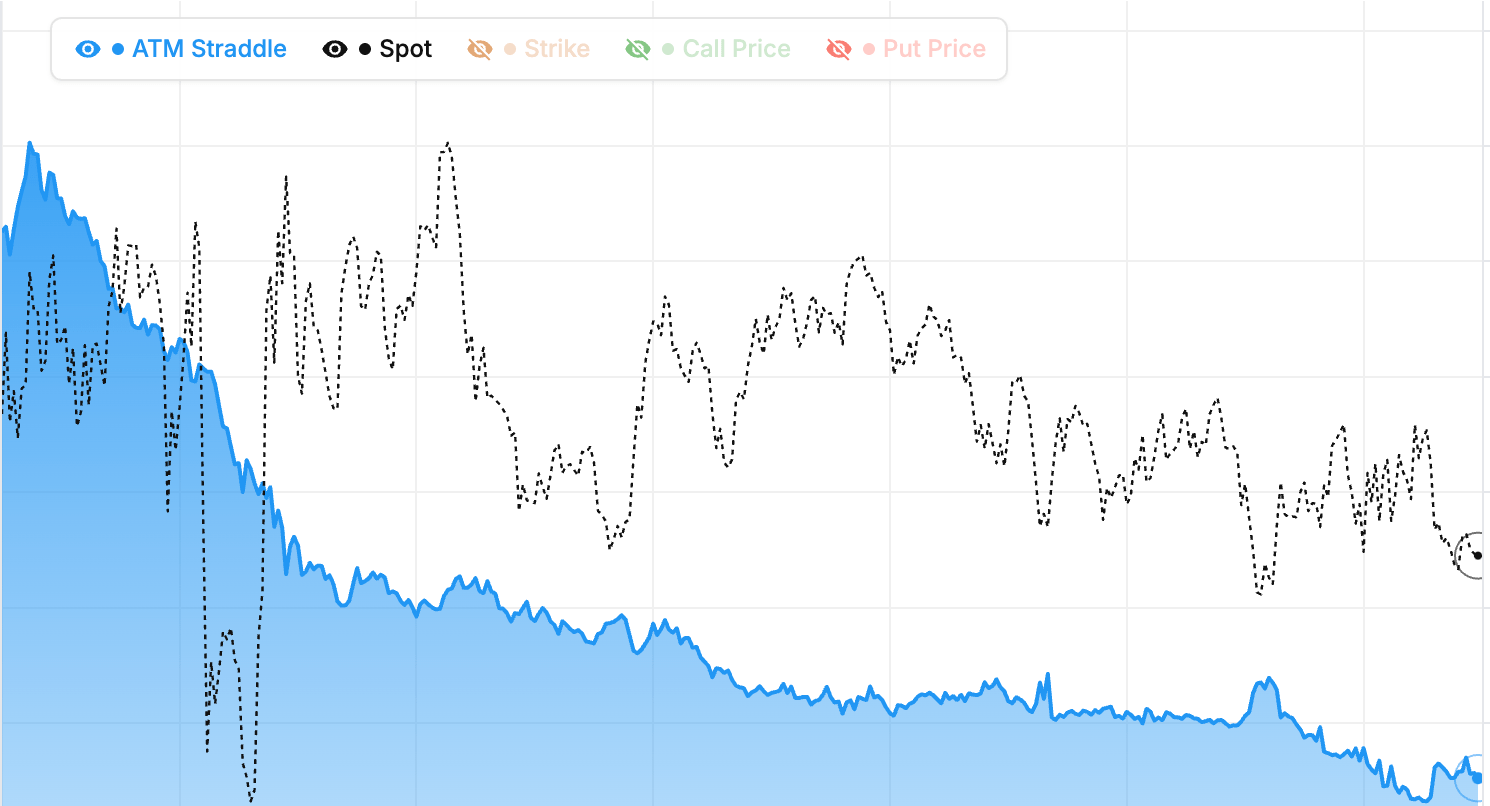
ATM straddle premium for NIFTY is the sum of the at-the-money call and put prices, one number that captures what the option market believes about the underlying's near-term volatility. Our rolling straddle chart tracks that combined premium continuously and re-centres on the new ATM strike as spot moves, so you're seeing the pure cost of volatility rather than the noise of individual strikes ticking in and out of ATM.
For NIFTY, the ATM straddle also gives you the market-implied expected move: roughly 0.85 times the straddle premium until expiry. If the NIFTYweekly straddle prints at 200, the market is pricing roughly a ±170 move over the remainder of the week. Traders use this to set realistic targets and position sizes, and option sellers use it to decide whether the premium is rich enough to justify the implied range. You can also watch the premium decay through the day. Theta burns most aggressively in the last 90 minutes of a NIFTY weekly expiry.
How to use the NIFTY straddle chart
A rising NIFTY straddle premium through the session signals volatility expansion, usually driven by an unexpected news catalyst or a fast directional move. When the straddle keeps falling while spot barely moves, that's classic pre-expiry theta decay, the bread and butter of option-selling strategies. Watch the ATM straddle around major events like RBI policy, budget announcements, and monthly expiry to see how the market's volatility expectations are being repriced in real time. Live mode streams NIFTY straddle updates throughout the NSE session.
Combine with our Premium Decay Chart, IV Chart, and Live Option Chain for complete NIFTY volatility and premium analysis on NSE F&O.
Nifty 50 (NIFTY) Straddle Chart: Identifying IV Crush
What is IV crush and how does it appear on the NIFTY chart?
IV crush is a sharp decline in implied volatility, usually triggered by an event resolving (RBI policy, budget announcement, election results). Before the event, options premiums are inflated because traders are hedging against uncertainty. After the event, uncertainty disappears and premiums collapse. On the NIFTY straddle chart, IV crush appears as a sharp, sudden drop in the straddle line — often in the first 15-30 minutes after the event.
Why IV crush is so important for NIFTY traders
If you bought Nifty 50 options before an event, you are at risk of IV crush even if NIFTY moves in your favoured direction. The IV collapse can wipe out your gains. If you correctly predicted the direction but still lost money, IV crush was probably the reason. Straddle sellers, on the other hand, benefit from IV crush — they profit both from theta decay and from the volatility contraction. Understanding this dynamic prevents the common mistake of buying expensive options before events.
Spotting pre-event IV inflation
In the days leading up to a major event, the NIFTY straddle chart typically rises steadily. You can see volatility being priced in as the event approaches. If the usual ATM straddle is around Rs. 150 and it rises to Rs. 250 over 3-4 sessions without Nifty 50 moving much, the extra Rs. 100 is pure IV inflation. This is your warning that premiums are about to crash once the event resolves.
Strategies around NIFTY IV crush
Strategy 1: Short straddle or iron condor before the event, captured the crush. Strategy 2: Wait for the event to pass, then buy options after IV has normalised — cheaper entry, direction still playable. Strategy 3: Avoid buying options in the 1-2 days before events. Strategy 4: Watch for IV crush patterns on the straddle chart to confirm when the crush has completed. As of 21 September 2026, these approaches help you navigate event-driven NIFTY volatility safely.
Nifty 50 (NIFTY) Straddle Chart: Reading Volatility Changes
How the NIFTY straddle reveals volatility shifts
Volatility is an abstract concept — you cannot see it directly. But you can see it through the straddle chart. The Nifty 50 ATM straddle price is essentially a pure volatility instrument (when viewed through auto-rolling mode). Rising straddle = rising volatility. Falling straddle = falling volatility. This simple relationship makes the straddle chart one of the clearest volatility visualizations available for Indian options traders.
Volatility expansion signals on NIFTY
When the NIFTY straddle line rises meaningfully (say, 15-20% over a few hours), volatility is expanding. This often precedes a directional move or follows breaking news. Volatility expansion in Nifty 50 tends to cluster — once it starts, it often continues for several sessions. Recognising the expansion early gives you time to adjust strategies: avoid short premium, consider long premium, widen your expected move assumptions.
Volatility contraction signals on NIFTY
The opposite pattern — a sustained decline in the Nifty 50 straddle beyond normal theta decay — signals volatility contraction. This usually happens after events resolve or during extended range-bound periods. Contracted volatility is the ideal environment for premium selling. Short straddles, iron condors, and calendar spreads all benefit from falling volatility. As of 21 September 2026, a contracting straddle chart is an invitation to short premium with appropriate risk controls.
Using the chart shape to classify NIFTY volatility regimes
Different chart shapes correspond to different volatility regimes. Smooth gradual decline = stable low-volatility regime. Gradual rise = volatility is building, something is coming. Sharp spike followed by crash = event-driven volatility (before and after an event). Sideways with small zigzags = directional price action but stable volatility. Each regime calls for different trading tactics. Learning to read the chart shape gives you a fast classification system for Nifty 50 conditions.
Nifty 50 (NIFTY) Straddle Chart: Building a Daily Routine
Pre-market NIFTY straddle check
Before the NSE opens, check the previous day's Nifty 50 closing straddle value. Compare to the past week's average. Is today starting from a normal level, an elevated level, or a compressed level? Check the event calendar for any scheduled announcements. These 2-3 data points set your context before the first tick of the day. The pre-market routine takes under 2 minutes.
Opening bell NIFTY straddle observation
At 9:15 AM, watch the NIFTY straddle chart for its opening behaviour. Is it ticking down (normal theta decay starting)? Is it spiking (overnight news or institutional positioning)? Is it volatile (broad uncertainty)? The first 15-30 minutes often set the tone for the rest of the session. Decisions made on the opening data are often more accurate than afternoon decisions because you have not been worn down by noise yet.
Mid-day NIFTY straddle reassessment
Between 11:30 AM and 1:30 PM, the Nifty 50 straddle usually decays slowly. If decay is happening normally, your context is confirmed. If something unusual is happening (volatility spike, flat line), adjust your active positions. Mid-day is also when the "lunch lull" often produces the cleanest theta capture for premium sellers — the quieter the price action, the faster the premium decays.
End-of-day NIFTY straddle closure check
In the final hour (2:30-3:30 PM), the NIFTY straddle decay accelerates. This is prime time for premium sellers to capture theta. At 3:30 PM close, note where the straddle ended. How does that compare to your expectation? Did anything unusual happen? These observations feed into tomorrow's planning. As of 21 September 2026, traders who consistently follow this 5-minute routine build much stronger intuition for Nifty 50 than those who glance at the chart occasionally.
Straddle Chart: Video Walkthrough
NIFTY ATM straddle premium: quick reference
| Straddle premium | What's driving it | Volatility & theta read |
|---|---|---|
| Expanding fast | News catalyst or sharp move in NIFTY | Expected move re-pricing higher; long straddles gain, short premium hurts |
| Drifting up vs flat spot | IV expansion ahead of an event | Vega is overpowering theta; market bracing for a bigger move |
| Flat / holding steady | Steady IV offsetting normal decay | Expected move unchanged; watch for a breakout to resolve it |
| Slow steady decay | Quiet, range-bound NIFTY tape | Theta doing its job; classic premium-selling environment |
| Sharp collapse | Post-event IV crush or expiry-day theta | Extrinsic value evaporating; sellers win, long straddles bleed out |
These regimes describe how the combined ATM call-plus-put premium behaves, not a price target. On NIFTY, an expanding straddle warns of volatility expansion while a steady decay rewards option sellers. The live chart above re-centres on the ATM strike every minute during market hours, so you can see which regime NIFTY is trading in right now.
How to use the Straddle Chart
- Pick an underlying and expiry — Select Nifty, BankNifty, or an F&O stock and choose the expiry to track.
- Read the current straddle premium — The latest value approximates the market's implied move through expiry.
- Look at the intraday slope — Steady decay points to a range-bound market. A rising premium tells you IV is expanding or a move is underway.
- Compare with prior expiries — Use historical mode to see how today's straddle premium compares to the same time slot in previous weeks.
- Cross-reference with Max Pain — Combine the straddle reading (size of expected move) with the Max Pain strike (likely target) to plan an expiry-day setup.
NIFTY Straddle Chart — Frequently Asked Questions
What is NIFTY straddle price today?
The NIFTY straddle price is the combined premium of ATM call and put options. It represents the market's expected move for the expiry. A straddle of 200 means market expects roughly 170 points move (0.85x) in either direction.
How to trade NIFTY straddle?
To trade a NIFTY straddle, buy it when you expect a big move (ahead of events) and sell it when you expect a range-bound market. Watch the decay through the day. Sellers collect theta, while buyers need the underlying to actually move.
What is NIFTY expected move from straddle?
The expected move is approximately 0.85x the NIFTY straddle price. This gives you a probabilistic range for the underlying's movement until expiry. Use this to set realistic targets and stop losses.
Why does the NIFTY straddle premium decay through the day?
The NIFTY ATM straddle is pure extrinsic value (time value plus implied volatility), so it has no intrinsic price to fall back on. Theta erodes that value every minute the underlying stays still, and the decay accelerates sharply as expiry nears. On expiry day a range-bound NIFTY straddle can shed 50-80% of its premium in one session.
How often does the NIFTY straddle chart update?
During NSE market hours (9:15 AM to 3:40 PM IST) the NIFTY straddle chart refreshes every minute, re-centring on the new ATM strike as spot moves so the line stays a true rolling straddle. Outside market hours it shows the last traded session, and historical mode replays NIFTY straddle premium for any past expiry.