SENSEX Vega Analysis | Live Call & Put Vega
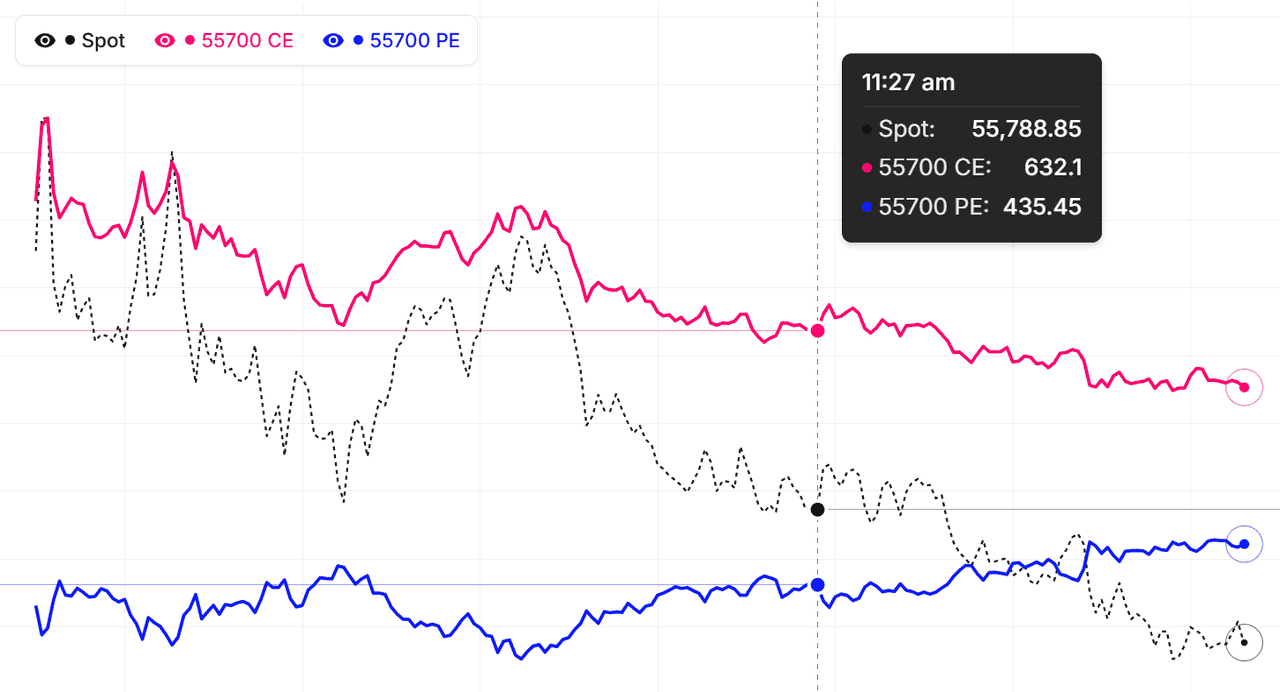
Vega Analysis for SENSEX plots total Call Vega and total Put Vega across a band of strikes around the money. For every minute it solves implied volatility from each option's traded price, reads the vega, and sums the calls into one line and the puts into another — so you can see how SENSEX volatility exposure builds and unwinds through the session.
Because each SENSEX call and put trades at its own implied volatility, the two vega lines diverge with the skew. A put-vega line above call-vega reflects downside-fear skew; call-vega leading points to upside-volatility demand. Live mode streams every selected SENSEX strike in real time.
Using SENSEX vega in context
Pair Vega Analysis with our Volatility Skew, IV Chart, and Multi-Strike Chart tools for richer SENSEX volatility analysis on NSE.
Strikes re-centre on the latest-minute ATM
BSE Sensex (SENSEX) Vega: Why Calls and Puts Diverge
Shouldn't a call and put have the same vega?
In the textbook Black-Scholes model, a call and a put at the same strike and the same implied volatility have identical vega. In the live SENSEX market they do not, because the call and put at a strike trade at different implied volatilities — the volatility skew. Vega is derived from each option's own market price, so the call-side and put-side vega lines for BSE Sensex separate exactly to the degree the skew is present.
What a widening gap tells you on SENSEX
When put vega pulls away from call vega, demand for downside protection is bidding up put implied volatility — a defensive, risk-off tone. When call vega leads, upside-volatility demand is dominating, which can accompany momentum or short-covering. Tracking the gap intraday on BSE Sensex gives an early, price-independent read on positioning.
Combining vega with skew tools
Pair Vega Analysis with the Volatility Skew and IV Chart views for SENSEX. Skew shows the IV shape across strikes at a moment; Vega Analysis shows how the aggregate call/put volatility exposure built up and unwound through the session. Together they explain both the level and the time dynamics of BSE Sensex volatility.
BSE Sensex (SENSEX) Vega Analysis: Live and Historical Modes
Live mode
Live mode streams the current SENSEX session and refreshes the Call and Put Vega lines as new prices arrive, so you can watch volatility exposure build and unwind in real time around the ATM window you chose.
Historical replay
Switch to Historical mode and pick any past trading day to replay that day's intraday BSE Sensex option prices and rebuild the vega lines exactly as they appeared. This is the practical way to study how volatility exposure reacted around results, policy events, or expiry on SENSEX.
Putting it to work
Compare a calm BSE Sensex session against a volatile one in historical mode to learn the normal range of the call/put vega gap. As of 13 October 2026, that baseline makes it far easier to recognise when today's live reading is unusual and worth acting on.
BSE Sensex (SENSEX) Vega Analysis: Choosing the ATM Window
How the ATM strike is found
The tool reads the live SENSEX option chain, takes the spot/future level, and snaps to the nearest available strike to define ATM. The "Strikes around ATM (±)" control then builds a symmetric window — ATM ± 3, for instance, covers seven BSE Sensex strikes, each contributing its call and its put to the totals.
Why the window is capped at ATM ± 4
The intraday price feed returns at most 20 option legs per request. Since Vega Analysis pulls both the call and the put for every strike, ATM ± 4 (nine strikes × two = eighteen legs) is the widest symmetric window that fits. Vega is concentrated near ATM anyway, so this band captures the bulk of SENSEX volatility exposure.
Narrow vs wide windows on SENSEX
A narrow window (ATM ± 1) isolates the strikes most sensitive to volatility and gives a cleaner read of the core exposure. A wider window (ATM ± 4) captures more of the BSE Sensex chain and smooths out single-strike noise. As of 13 October 2026, start narrow to see the signal, then widen to confirm the aggregate picture.
SENSEX vega by strike zone: quick reference
| Strike zone | Vega concentration | If IV rises +1% | If IV falls −1% |
|---|---|---|---|
| ATM (at the money) | Peak vega — most IV-sensitive | Largest premium gain for long options | Largest premium loss (IV crush) |
| Near-money (±1–2 strikes) | High, tapering off ATM | Meaningful premium lift on SENSEX | Meaningful premium erosion |
| Far OTM / ITM (±3–4 strikes) | Low to moderate | Modest premium change | Modest premium change |
| Deep wings | Negligible vega | Little reaction to IV | Little reaction to IV |
Vega is largest at the money and in longer-dated expiries, so ATM SENSEX options move most when implied volatility shifts. Ahead of events — the Budget, an RBI decision, or results — IV inflates and lifts vega across strikes; the post-event IV crush then reverses it. The live chart above splits Call and Put Vega so you can see which side's volatility exposure is building.
How to use Vega Analysis
- Pick the underlying — Choose Nifty, BankNifty, or any F&O stock from the symbol selector.
- Choose live or historical — Live streams the current session. Historical lets you replay a past trading day.
- Select the expiry — Pick the expiry whose strikes you want to analyse.
- Set the ATM range — Choose how many strikes around ATM to include (ATM ± 1 up to ATM ± 4). Both call and put are included for each strike.
- Read the two vega lines — Watch total Call Vega vs total Put Vega through the day. A widening gap signals call/put volatility-exposure imbalance driven by skew.
SENSEX Vega Analysis — Frequently Asked Questions
What is SENSEX Vega Analysis?
SENSEX Vega Analysis plots two intraday lines — total Call Vega and total Put Vega across a band of strikes around ATM — by solving implied volatility from each option's traded price and summing its vega. It shows how SENSEX option volatility exposure evolves through the session.
Why do SENSEX Call Vega and Put Vega differ?
A call and put at the same strike share the same vega only at the same implied volatility. In the SENSEX market each trades at its own IV (the skew), so the call-side and put-side vega lines diverge — a direct, price-independent read on volatility positioning.
Which SENSEX strikes carry the most vega?
Vega peaks at the at-the-money strike and tapers toward deep in- and out-of-the-money strikes, so ATM SENSEX options are the most sensitive to implied-volatility moves. Longer-dated expiries also carry more vega than weekly ones, which is why the chart windows strikes tightly around ATM to capture the bulk of the exposure.
What happens to SENSEX options when IV rises or falls?
Vega measures how much an option's price moves for a one-point change in implied volatility. When IV rises, both SENSEX calls and puts gain premium; when IV falls — the classic post-event IV crush — long options lose value even if spot is unchanged. ATM positions feel this the most.
How often does the SENSEX Vega Analysis chart update?
During NSE market hours (9:15 AM to 3:40 PM IST) the SENSEX Vega Analysis chart refreshes every minute, recomputing Call and Put Vega from live option prices. Outside market hours it shows the last session, and Historical mode replays intraday vega for any past SENSEX trading day.
Learn more
Read our guide: Option Greeks Explained: Delta, Gamma, Theta, Vega & Rho