Nifty 50 Weightage — Live Stock Constituents & Sector Composition
NIFTY Stocks Weightage
0 StocksAbout Nifty 50 Index Weightage
Weightage decides how much each constituent stock influences Nifty 50, BankNifty, FinNifty, Sensex, and the sectoral indices. The tool surfaces live weightages for every constituent, sorted by impact, with sector-wise rollups. Because the top 10 names typically account for 55-60% of Nifty 50, knowing the weightage is what separates correctly interpreting an index move from being surprised by it.
Practical example. When Reliance (around 9% weight) and HDFC Bank (around 11%) both move 2% in the same direction, Nifty 50 can jump 40+ points from those two names alone. Anyone trading Nifty futures or options off broad-based momentum needs to know whether the move they're looking at came from a few heavyweights or genuinely from most of the index. This tool answers that instantly. Combined with our Advance Decline Ratio, it tells you whether an index move is narrow or broad.
Using weightage for trade decisions
Positional options traders should check heavyweight positioning before entering directional Nifty bets. If Reliance and HDFC Bank are in their own downtrends, even a bullish Nifty view faces structural headwind. Sector-wise breakdowns reveal rotation. IT weightage contribution dropping while banks are rising is the kind of undercurrent that shapes multi-week index behaviour. Sorting by live change-impact shows the single biggest mover behind today's index move, which is useful both for macro commentary and for deciding which names to hedge separately.
Combine weightage with our Index Contributors, Advance Decline Ratio, and Market Movers for fuller NSE index internals research.
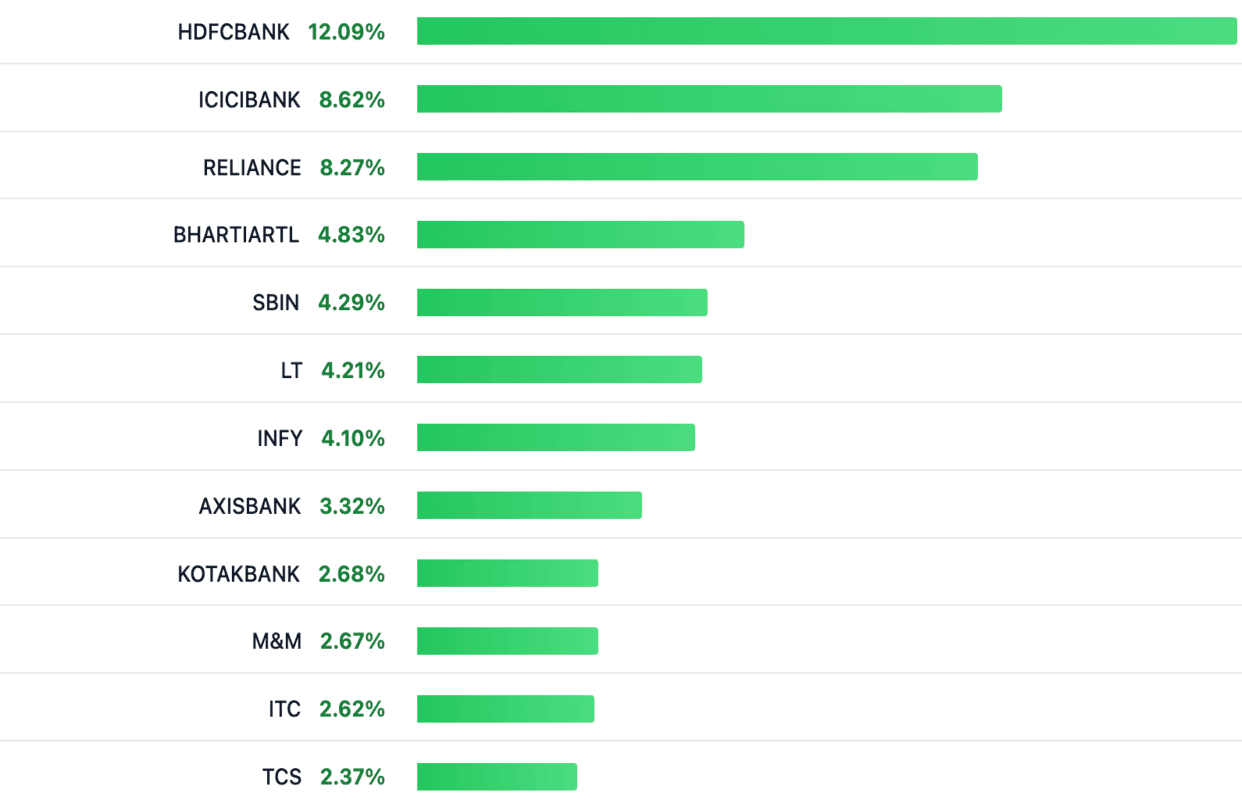
Nifty 50 Stocks List with Weightage
All 50 constituents of the Nifty 50 index ranked by free-float weightage, as of 29 Sept 2026 — the table above this section shows live weights updated during market hours.
| # | Stock | Nifty 50 Weightage |
|---|---|---|
| 1 | HDFCBANK | 9.89% |
| 2 | ICICIBANK | 9.35% |
| 3 | RELIANCE | 8.02% |
| 4 | BHARTIARTL | 5.30% |
| 5 | LT | 4.23% |
| 6 | SBIN | 3.88% |
| 7 | INFY | 3.68% |
| 8 | AXISBANK | 3.28% |
| 9 | KOTAKBANK | 2.84% |
| 10 | M&M | 2.64% |
| 11 | BAJFINANCE | 2.56% |
| 12 | ITC | 2.33% |
| 13 | TCS | 2.19% |
| 14 | ETERNAL | 2.15% |
| 15 | TITAN | 1.89% |
| 16 | SUNPHARMA | 1.85% |
| 17 | HINDUNILVR | 1.61% |
| 18 | MARUTI | 1.53% |
| 19 | NTPC | 1.41% |
| 20 | TATASTEEL | 1.38% |
| 21 | SHRIRAMFIN | 1.35% |
| 22 | BEL | 1.34% |
| 23 | HINDALCO | 1.33% |
| 24 | HCLTECH | 1.29% |
| 25 | ULTRACEMCO | 1.22% |
| 26 | BAJAJ-AUTO | 1.22% |
| 27 | GRASIM | 1.13% |
| 28 | JSWSTEEL | 1.12% |
| 29 | ADANIPORTS | 1.10% |
| 30 | POWERGRID | 1.09% |
| 31 | ASIANPAINT | 1.06% |
| 32 | INDIGO | 1.04% |
| 33 | BAJAJFINSV | 1.04% |
| 34 | EICHERMOT | 1.00% |
| 35 | TECHM | 0.94% |
| 36 | NESTLEIND | 0.94% |
| 37 | COALINDIA | 0.87% |
| 38 | TRENT | 0.86% |
| 39 | ONGC | 0.83% |
| 40 | APOLLOHOSP | 0.82% |
| 41 | ADANIENT | 0.78% |
| 42 | CIPLA | 0.73% |
| 43 | SBILIFE | 0.71% |
| 44 | JIOFIN | 0.70% |
| 45 | MAXHEALTH | 0.68% |
| 46 | DRREDDY | 0.65% |
| 47 | TATACONSUM | 0.61% |
| 48 | TMPV | 0.59% |
| 49 | HDFCLIFE | 0.53% |
| 50 | WIPRO | 0.45% |
HDFCBANK has the highest weightage in Nifty 50 at 9.89%. The top 10 stocks together make up roughly 53% of the index, so these heavyweights drive most of its daily movement. View the live weightages and sector-wise breakdown in the tool above.
Frequently Asked Questions
What is index weightage?
Index weightage is the percentage each constituent stock represents within an index. In Nifty 50 for example, HDFC Bank holds roughly 11%, Reliance about 9%, and Infosys about 6% — these weights determine how much each stock's price movement affects the headline index number.
How are Nifty 50 weights calculated?
Nifty 50 uses free-float market capitalization weighting. Each stock's weight equals its free-float market cap divided by the sum of all 50 stocks' free-float market caps, expressed as a percent. The weights shift daily as prices move and are rebalanced quarterly by the index committee.
Why do the top 10 stocks matter so much?
The top 10 Nifty 50 stocks typically account for 55-60% of the index. When these heavyweights move strongly in one direction, they can single-handedly drive Nifty even if the remaining 40 stocks are flat. Understanding this concentration is essential for correctly interpreting index moves.
Which indices can I check weightage for?
We cover all major NSE indices: Nifty 50, BankNifty, FinNifty, MidcpNifty, Nifty Next 50, Sensex, and the major sectoral indices (IT, banking, auto, pharma, metals, FMCG, realty, PSU bank, private bank). Each has its own constituent weightage table.
How often do weights change?
Weights drift continuously with price movements — if Reliance outperforms the rest of Nifty over a month, its weight rises mechanically. Formal rebalancing happens quarterly when the index committee reviews eligibility criteria and may add or remove constituents. Major rebalances can shift weights by 0.5-1.5% for some names.
How does weightage affect my options trading?
It determines how much a stock-specific event (e.g., HDFC Bank results) will move the index. If you're selling Nifty puts expecting stability, but heavyweight HDFC Bank reports weak results, the index can drop sharply even if broader breadth is positive. Weightage awareness prevents this kind of surprise.
How to use the Index Weightage tool
- Select an index — Choose Nifty 50, BankNifty, FinNifty, or any sectoral index you want to inspect.
- Scan the top 10 weights — The top 10 constituents typically drive most of the index move. Note which stocks dominate and at what weight.
- Check sector-wise rollup — Group constituents by sector to see whether the index is tilted toward IT, banking, energy, or another sector — helps with sector rotation reads.
- Review live impact — The live impact column shows each stock's contribution to today's index move based on current price change × weight.
- Apply to your strategy — When planning Nifty options, check whether your thesis depends on heavyweight names cooperating. If heavyweights are likely to diverge from broad breadth, adjust strikes or size.