NIFTY Contribution & Index Movers - Live NSE Today
Track live NIFTY contributors and index movers. See real-time points contribution, stock weightage, and top positive/negative movers today on the NSE.
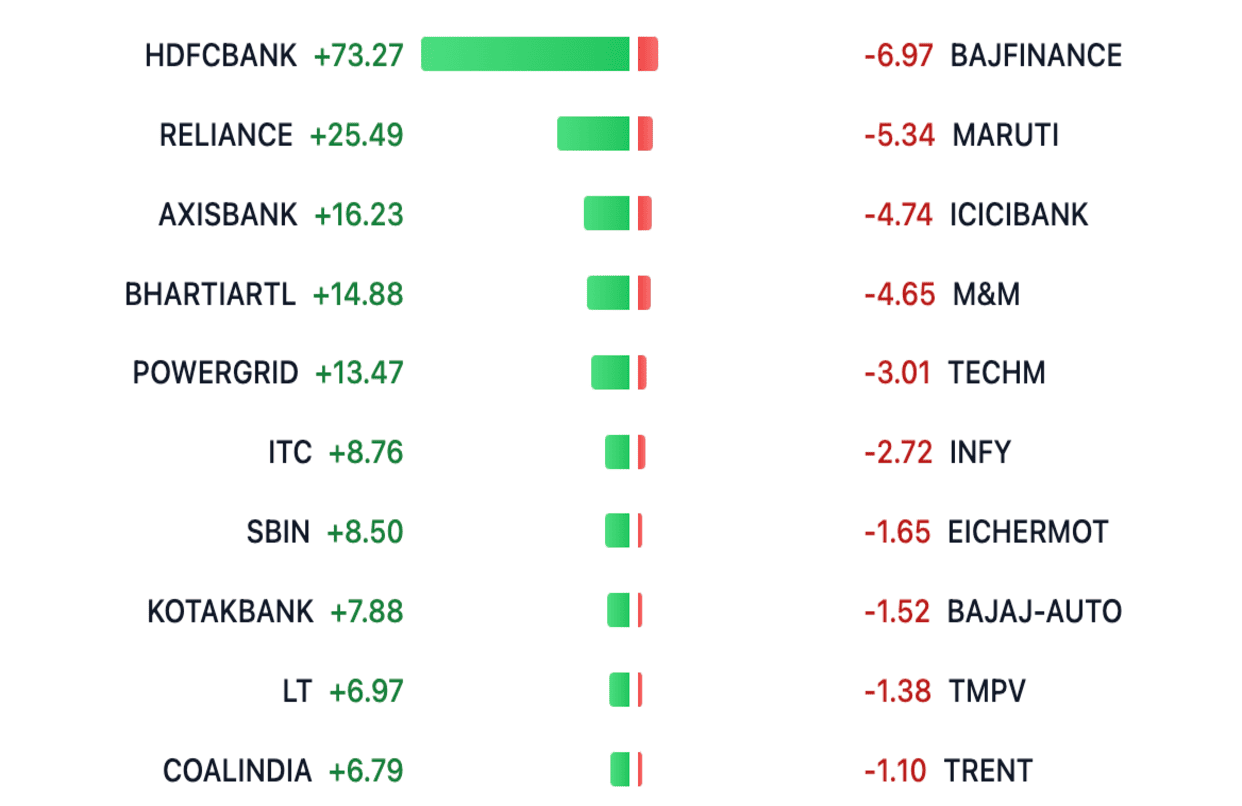
Index Contribution
NIFTY Index Contribution
Positive Contributors
0NIFTY Points Contribution
Negative Contributors
0Frequently Asked Questions about NIFTY Contribution
How is NIFTY Contribution calculated?
Understanding NIFTY Index Contributors
What is NIFTY Contribution?
In the stock market, an index like the NIFTY is composed of multiple stocks, each holding a specific weightage based on its free-float market capitalization. When we talk about NIFTY contribution today, we are measuring precisely how many points a single stock has added to, or subtracted from, the overall index value.
A stock's price change alone doesn't tell the whole story. A stock making a huge percentage move might have a minimal impact on the index if its weightage is low. Conversely, a heavy-weight stock moving just a fraction of a percent can significantly move the entire index. Tracking these index movers gives traders a clear picture of market breadth and institutional activity.
Key Terms: Pullers, Draggers, and Weightage
- Pullers (Positive Contributors): These are the stocks that are positively pulling the index up. When you look at the positive contributors in NIFTY, you see the exact points they've added.
- Draggers (Negative Contributors): These are the stocks pulling the index down. Even on a green day for the market, heavy-weight draggers can suppress an otherwise strong rally.
- Stock Weightage Impact: A stock with a 10% weightage will impact the index twice as much as a stock with a 5% weightage, assuming equal percentage price movement.
Why Track Index Movers Live?
Successful day traders and investors monitor live NIFTY contributors to identify sector rotation and market dependency. If the NIFTY is up by 100 points, but 80 of those points are coming from just two stocks, the rally may be fragile (narrow market breadth). However, if the contribution is evenly distributed across many components, the trend is generally considered more robust and reliable.
NIFTY Points Contribution Snapshot
Data as of 6 Oct 2026, 3:30 pm IST. The tool above shows live values during market hours; this snapshot refreshes with every site update.
As of 6 Oct 2026, 3:30 pm IST, NIFTY was at 22,776.10, up 220.3 points (+0.98%) versus the previous close. Positive contributors added 263.6 points while negative contributors dragged 43.2 points. RELIANCE added the most points (+45.3). COALINDIA dragged the most (-6.9).
Top Points Added
| Stock | Points | Change |
|---|---|---|
| RELIANCE | +45.3 | +2.66% |
| KOTAKBANK | +24.6 | +3.82% |
| TRENT | +23.8 | +12.64% |
| HDFCBANK | +22.5 | +0.94% |
| BHARTIARTL | +19.9 | +1.72% |
| ICICIBANK | +16.1 | +0.81% |
| AXISBANK | +15.8 | +2.11% |
| ETERNAL | +13.1 | +2.56% |
| BSE | +11.1 | +3.94% |
| HINDUNILVR | +11.0 | +3.09% |
Top Points Dragged
| Stock | Points | Change |
|---|---|---|
| COALINDIA | -6.9 | -3.16% |
| INFY | -5.0 | -0.65% |
| ITC | -4.5 | -0.82% |
| TECHM | -4.2 | -2.04% |
| BAJFINANCE | -4.1 | -0.71% |
| TCS | -3.0 | -0.68% |
| TITAN | -2.7 | -0.66% |
| ULTRACEMCO | -2.5 | -0.92% |
| MAXHEALTH | -2.5 | -1.58% |
| SHRIRAMFIN | -1.9 | -0.65% |