NIFTY Futures Price vs OI Analysis Today | Live NSE Data
Master the derivatives market with StockMojo's NIFTY Futures Price vs Open Interest (OI) divergence analysis. Our real-time tool tracks the relationship between price action and unsettled contracts to help traders identify high-probability trend reversals and continuation signals.
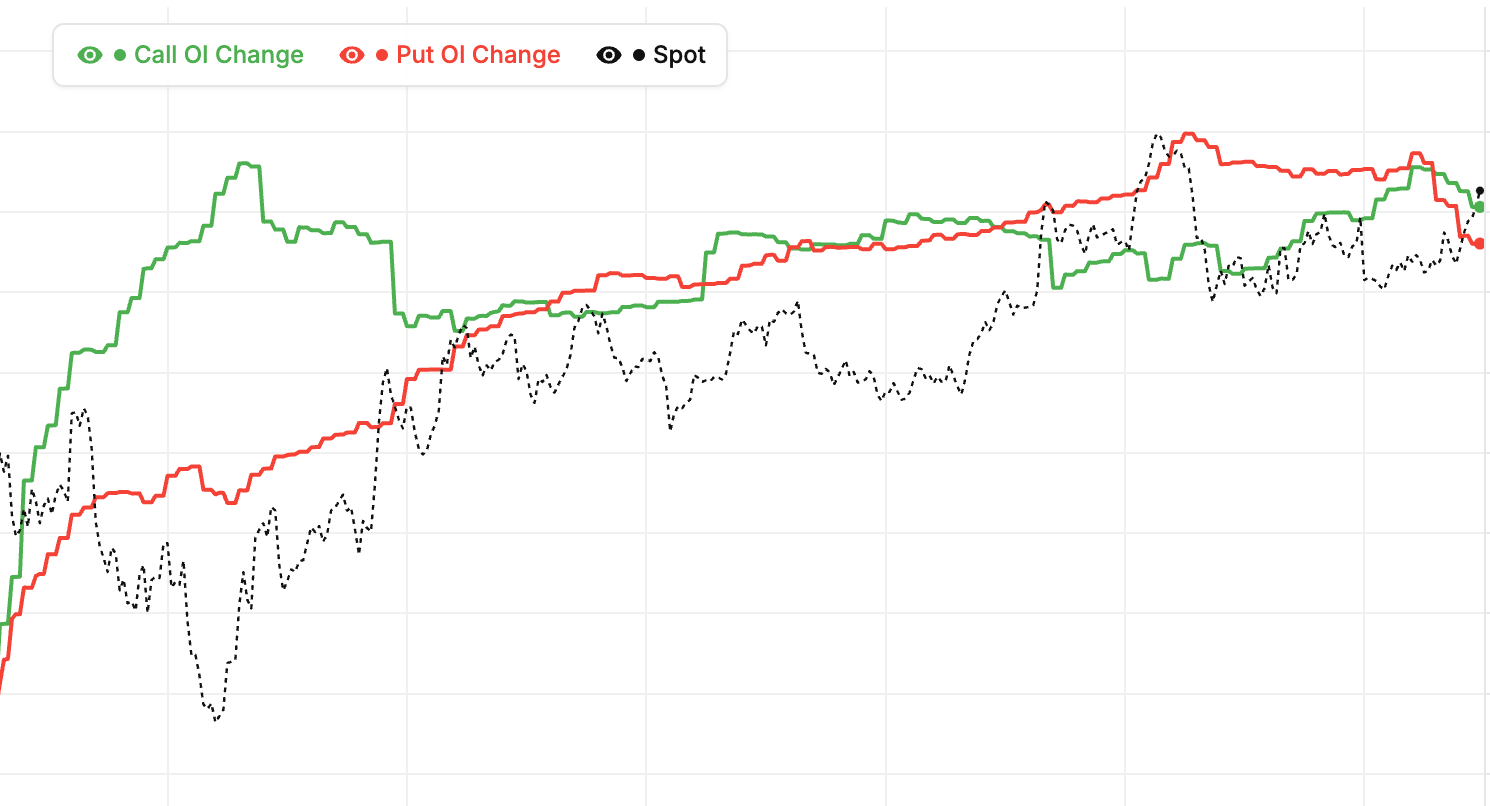
By visualizing NIFTY futures price vs OI on a single chart, you can quickly spot buildup patterns: Long Buildup (Price Up, OI Up), Short Buildup (Price Down, OI Up), Short Covering (Price Up, OI Down), and Long Unwinding (Price Down, OI Down). Understanding these four phases of the market cycle is crucial for professional futures and options trading. Analyze intra-day shifts or historical trends to confirm the strength of a price move.
Gain deeper insights into market activity with our Future Intraday Analysis,Smart OI, and Future Heatmap tools.
Nifty 50 (NIFTY) Future Price vs OI: Event-Driven Trades
How events affect NIFTY futures
Major events cause sharp moves in Nifty 50 futures. Volume spikes, OI shifts dramatically, and the chart shows aggressive buildup or unwinding. Experienced traders profit from event-driven moves; inexperienced traders often get hurt by the volatility. The key is preparation and risk management.
Pre-event positioning
Before known events, reduce position size or close existing trades. Volatility will be elevated. The chart may show distorted patterns due to hedging rather than directional conviction. Fresh directional trades before events have too much uncertainty — wait for the event to reveal direction.
Post-event trade entries on NIFTY
After the event resolves, watch the chart for the first few minutes. Which side is the OI growing on? Which direction is price moving? Enter in the direction of the combined signal with tight stops. Post-event trades benefit from cleaner signals than pre-event positioning.
Risk during events on NIFTY as of 17 September 2026
Event-driven volatility can overwhelm stops. Use defined-risk structures when possible. Limit position size. Be prepared for unexpected outcomes. Many traders size up for events and get caught on the wrong side. Conservative sizing and discipline protect capital during these high-variance periods on Nifty 50.
Nifty 50 (NIFTY) Future Price vs OI: Pro Tips
Tip 1: always prioritize fresh positioning
Rising OI is the most actionable signal on the chart. It represents real capital entering the market. Focus your analysis on strikes and price levels where OI is actively growing. Old OI without changes is less useful for current decisions on Nifty 50.
Tip 2: combine with price chart analysis
Never rely on OI alone. Combine with price action, technical levels, and chart patterns. Multi-signal confirmation dramatically improves win rates. Two independent signals agreeing is always better than one signal you trust.
Tip 3: respect the NIFTY event calendar
Know when major events are coming. Reduce exposure around them. Price vs OI signals can be distorted during event windows due to hedging activity. Event-aware trading protects capital during the most unpredictable periods.
Tip 4: journal every trade as of 17 September 2026
Write down setup, execution, and outcome for each Nifty 50 futures trade. After 100+ trades, patterns emerge — which setups work, which fail, where discipline slips. This data-driven improvement compounds into real skill over months. As a major Broad Market index on NSE, the futures market rewards disciplined traders who keep good records and learn continuously.
Nifty 50 (NIFTY) Future Price vs OI: Intraday Patterns
Opening-hour dynamics on NIFTY
In the first 30-60 minutes of trading, Nifty 50 futures price and OI show the overnight institutional decisions. Rapid OI growth with directional price movement signals fresh positioning. The pattern established in the opening hour often determines the day's overall direction.
Mid-session stability on NIFTY
Between 11 AM and 1:30 PM, OI changes are usually modest. Price can range, but significant positioning happens less frequently. Mid-session is better for managing existing positions than opening new ones. Signals are weaker during this window.
Final hour action on NIFTY
The last hour (2:30-3:30 PM) sees institutions make end-of-day positioning. Watch for: sudden OI spikes (large orders), direction shifts (positioning for tomorrow), and breakout confirmations. Final-hour OI changes are often the most predictive for next-session direction.
Full-session synthesis on NIFTY as of 17 September 2026
At market close, look at the full day's chart. Which buildup pattern dominated? Did it shift during the day? What was the final OI change? These observations become your starting framework for the next session. The pattern at close often persists into the next open.
NIFTY futures buildup phases: quick reference
| Futures price | Open interest | Phase | Common reading |
|---|---|---|---|
| Rising | Rising | Long buildup | Fresh longs entering NIFTY; genuinely bullish, tends to persist |
| Falling | Rising | Short buildup | Fresh shorts entering; genuinely bearish with real conviction |
| Rising | Falling | Short covering | Trapped shorts exiting; sharp but short-lived rally |
| Falling | Falling | Long unwinding | Longs booking out; decline often near exhaustion |
| Moving either way | Flat | No fresh positioning | Low-conviction move; weak base for continuation trades |
| Any | Sharp drop near expiry | Rollover | Positions migrating to the next series; read combined OI instead |
The four buildup phases are read from minute-to-minute changes, so a session can rotate through several phases before settling into one. The live NIFTY chart above plots futures price and open interest together and refreshes every minute during NSE market hours, letting you see which phase the contract is trading in right now.
How to read Future Price vs OI
- Pick an underlying — Choose an index (Nifty, BankNifty) for macro positioning or a stock for name-specific flow analysis.
- Classify the current phase — Check whether price and OI are both up (long buildup), both down (long unwinding), or divergent (short buildup or short covering).
- Watch for divergences — Divergences between price and OI are the most tradeable signals — they often mark reversals before price shows them.
- Use first-hour signal — The 9:15-10:15 IST window often sets the day's dominant price-OI pattern. A clear long buildup by 10:30 is high-conviction bullish for the session.
- Plan entry around phase transition — The cleanest entries come at the moment a phase changes — long unwinding flipping to long buildup, or vice versa, is a high-probability reversal setup.
NIFTY Futures Price vs OI — Frequently Asked Questions
What is NIFTY futures price vs OI?
NIFTY futures price vs OI compares price movement with OI changes. Price Up + OI Up = Long Buildup. Price Down + OI Up = Short Buildup. Price Up + OI Down = Short Covering. Price Down + OI Down = Long Unwinding. The phase tells you whether a NIFTY move is backed by fresh positions or driven by traders exiting old ones.
How reliable is NIFTY futures OI data?
NIFTY futures OI is highly reliable for trend confirmation because open interest is exchange-reported data representing actual outstanding contracts — real money committed to the market. Unlike indicators derived from price alone, it cannot be repainted. Its main limitation is expiry week, when rollover activity distorts single-series readings, so read the combined OI across series then.
What does long buildup in NIFTY futures mean?
Long buildup in NIFTY futures means price is rising while open interest is also rising — fresh long positions are being added with new money. It is the most reliable bullish phase because the up-move is backed by fresh commitment, and it tends to persist for multiple sessions rather than fading like a short-covering rally.
Can NIFTY futures price vs OI divergence predict trend reversals?
Yes — divergence between NIFTY futures price and open interest is one of the earliest reversal warnings. A rally with falling OI runs on short-covering fuel and usually stalls once shorts finish exiting; a decline with falling OI is long unwinding, often near exhaustion. Combine the divergence with price action at support or resistance before acting.
How often does NIFTY futures price vs OI update?
During NSE market hours (9:15 AM to 3:40 PM IST) the NIFTY futures price vs OI chart refreshes every minute from live futures contract data. Outside market hours the chart shows the last traded session, and historical mode lets you replay how NIFTY price and open interest interacted on any past trading day.