BANKNIFTY Straddle & Strangle Option Chain 2026 - Live CE+PE Premiums & Breakevens
Live and historical BANKNIFTY straddle and strangle option chain. Every row shows the call LTP, put LTP and combined premium for a strike or strike pair, with change against the selected time cycle, lower and upper breakevens and the breakeven range as a percentage of spot. Switch between Straddle and Strangle, or to Historical mode to replay any past date.
Bank Nifty (BANKNIFTY) Straddle & Strangle Option Chain: Reading the Premium Ladder
What does the BANKNIFTY straddle option chain show?
A normal option chain lists calls on one side and puts on the other and leaves the adding up to you. The BANKNIFTY straddle option chain does that addition for every strike. Each row is one strike with its call LTP, its put LTP and the combined premium you would pay to buy both, or collect to sell both. The ATM row is highlighted because the ATM straddle is the single most watched number in Bank Nifty options: it is the market's own estimate of how far the underlying can travel before expiry. Rows above and below ATM show how quickly that combined premium changes as you move away from the current price.
How is the BANKNIFTY strangle view different?
Switch the toggle to Strangle and the rows stop being single strikes and become strike pairs. OTM1 pairs the call one strike above ATM with the put one strike below, OTM2 pairs the next strike out on each side, and so on. ITM1 is the reverse pair, a call below ATM with a put above it, which traders call a guts strangle. The Strangle column is the combined premium of the pair. Reading down the OTM rows you can see exactly how much credit each extra strike of distance gives up, which is the core decision in building a short strangle on Bank Nifty.
What do Lower BE, Upper BE and Range % mean?
Lower BE is the put strike minus the combined premium and Upper BE is the call strike plus the combined premium. Between those two prices a short straddle or strangle finishes in profit at expiry, and a long one finishes in loss. Range % expresses the gap between the two breakevens as a percentage of the current BANKNIFTY price, so you can compare a wide strangle on a quiet day with a tight straddle on an event day without doing the division yourself. Index traders often compare Range % against the move implied by India VIX to judge whether premiums look rich or cheap.
How to read the premium change with the time cycle
The percentage beside the Strangle or Straddle premium shows how much the combined premium has moved against the baseline selected in the time cycle dropdown. On Prev Day it is the change since the previous close, which tells you whether BANKNIFTY straddles and strangles have expanded or decayed overnight and through the session. Switch to 15 Min or 1 Hour and the same figure becomes an intraday decay meter: a steadily negative percentage across OTM strangle rows is premium bleeding out, exactly what a seller wants to see and a buyer wants to avoid. As a major Banking index on NSE, BANKNIFTY premiums react quickly to news, so the cycle view helps you separate a genuine volatility shift from normal time decay.
Bank Nifty (BANKNIFTY) Straddle Price and the Expected Move
Why is the ATM straddle premium called the expected move?
When you buy the ATM call and the ATM put on BANKNIFTY, you profit only if the underlying moves further than the premium you paid, in either direction. Option sellers know this, so the price they charge for the ATM pair is their collective estimate of the likely move until expiry. That is why the highlighted ATM row in the BANKNIFTY straddle option chain doubles as an expected move indicator. If the ATM straddle on Bank Nifty is trading at a premium equal to about one percent of the spot price, the market is pricing a one percent move in either direction before this expiry.
How does the straddle premium change away from ATM?
Walk up the table from ATM and the call side gains intrinsic value while the put side loses it, so the combined premium rises but mostly through intrinsic value, not time value. The same happens walking down. The strike with the smallest combined premium is usually the one closest to the current price, and that minimum shifts as BANKNIFTY moves. Watching which row holds the lowest straddle price through the day is a quick way to see where the market thinks Bank Nifty is anchored.
Using the breakevens for a BANKNIFTY straddle trade
Lower BE and Upper BE on the ATM row are the two prices BANKNIFTY must cross for a long straddle to pay off at expiry. For a short straddle they are the edges of your profit zone. Compare them with the key levels you already track for Bank Nifty, such as the highest call OI strike and the highest put OI strike from the option chain. If the breakevens sit inside those OI walls, sellers have a cushion. If they sit outside, the market is pricing a move that would break the structure, and buying the straddle may be the better side.
Straddle on expiry day versus a week out
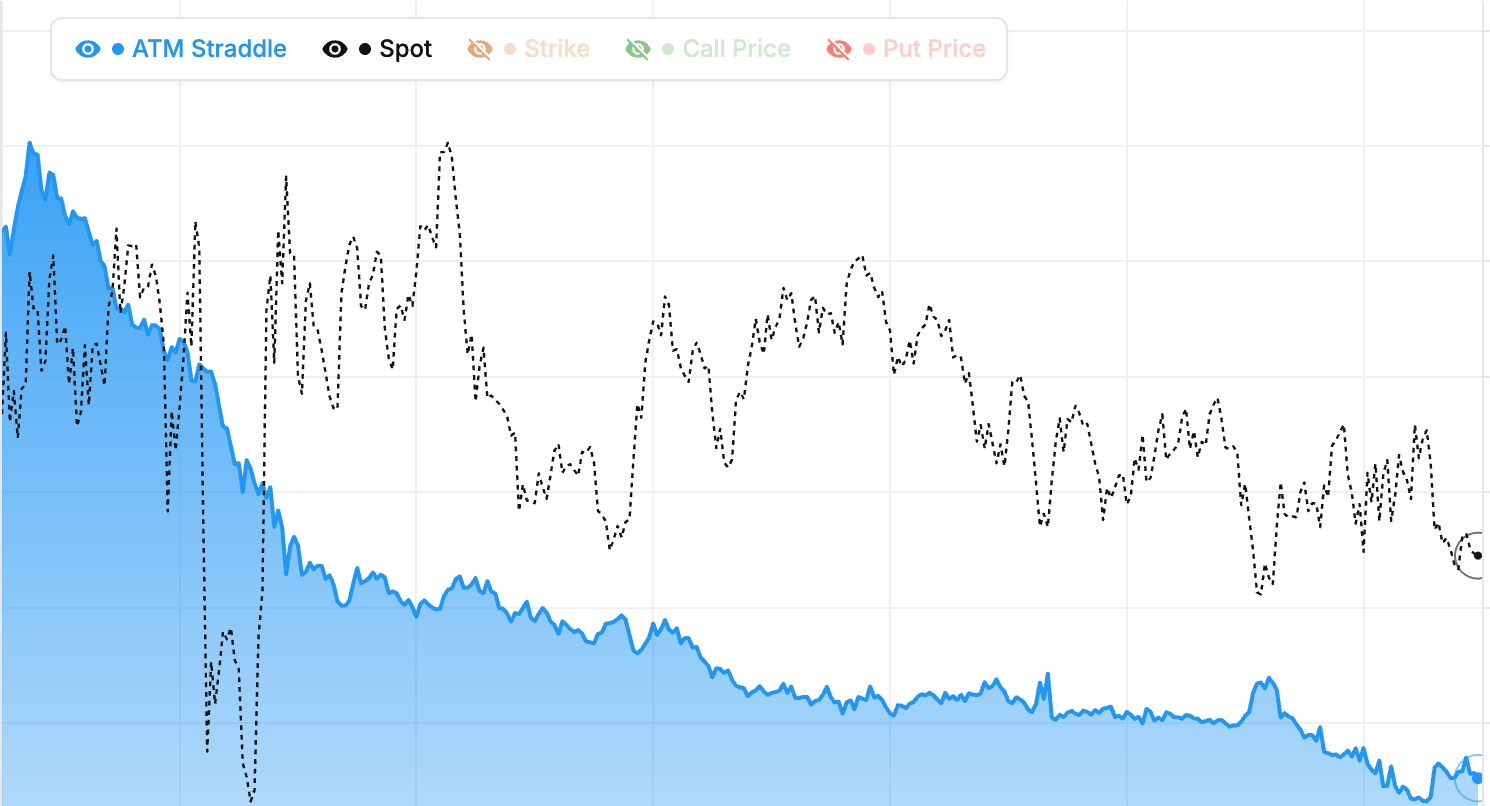
Time value is what the straddle is made of, and it decays fastest in the final sessions. A week before expiry the BANKNIFTY ATM straddle carries a wide buffer and moves slowly. On expiry morning the same row shows a much smaller premium and a Range % that is a fraction of the earlier value, which is why expiry day straddle selling is popular and why a sharp move on that day hurts sellers so badly. Switch to historical mode and load a past expiry date for Bank Nifty to see how the ATM straddle premium behaved hour by hour on that day.
Bank Nifty (BANKNIFTY) Strangle Chain: Picking Strikes for a Short Strangle
How far out should a BANKNIFTY short strangle go?
The strangle view answers this with numbers instead of guesswork. Each OTM row shows the credit you collect for that distance. Going from OTM1 to OTM3 on BANKNIFTY typically gives up a large share of the premium but widens the breakeven range considerably. The right row depends on how much Bank Nifty tends to move in the time left and how much margin you are willing to commit. Many traders look for the row where the Strangle premium is still meaningful but the breakevens sit beyond the recent trading range.
Reading Range % for strangle selection
Range % turns every strangle pair into a single comparable figure: how wide the profit zone is relative to the current BANKNIFTY price. A short strangle with a Range % well above the move implied by current volatility has room to absorb a surprise. One with a narrow Range % is really a straddle in disguise and should be treated with the same caution. Because Bank Nifty is an index, its realised moves are usually smaller than individual stocks, so a given Range % offers more cushion than the same figure on a single stock.
What the ITM rows tell you
The ITM rows in the BANKNIFTY strangle chain pair an in-the-money call with an in-the-money put. This guts strangle has a large combined premium because most of it is intrinsic value, and its breakevens are the same as the matching OTM pair. Traders rarely sell guts, but the rows are useful as a check: if the ITM1 premium minus the OTM1 premium is not close to the distance between the two strikes, one leg is mispriced or illiquid, and the quoted LTP may not be tradable.
Watching a BANKNIFTY strangle through the session
After you enter a strangle the percentage beside the premium becomes your position monitor. Set the time cycle to Intraday and the change on your chosen row is roughly your open profit or loss per unit of Bank Nifty, before slippage. If the underlying drifts toward one strike, that row's call or put LTP will start climbing while the other collapses, and the combined premium tells you whether the net effect is still in your favour. When the ATM row shifts to a new strike, the market has moved a full step and it is time to reassess the pair you hold.
BANKNIFTY straddle and strangle chain: quick reference
| Row or column | What it is | How to use it for BANKNIFTY |
|---|---|---|
| ATM row (Straddle) | Call + put premium at the at-the-money strike | Expected move until expiry; compare with recent realised moves |
| OTM1, OTM2, OTM3 (Strangle) | Call n strikes above ATM paired with put n strikes below | Credit vs distance trade-off for short strangles |
| ITM rows (Strangle) | In-the-money call below ATM paired with in-the-money put above | Guts strangle; same breakevens as the matching OTM pair |
| Lower BE / Upper BE | Put strike minus premium / call strike plus premium | Profit zone edges for sellers, targets for buyers |
| Range % | Breakeven width as a percentage of spot | Compare cushion across strikes, expiries and symbols |
| Premium % change | Change in the combined premium vs the selected time cycle, shown beside the premium | Decay meter for sellers; IV expansion alert for buyers |
Premiums are last traded prices, so far OTM pairs on illiquid BANKNIFTY expiries can show stale values. Confirm against the bid and ask before placing orders, and re-check the ATM row after any sharp move because every strangle pair re-centres when the ATM strike changes.
How StockMojo builds the BANKNIFTY straddle and strangle chain
The table is derived from the same live BANKNIFTY option chain feed as the StockMojo option chain. During market hours every row is recomputed as new ticks arrive; outside market hours it shows the last session's closing snapshot. Historical mode rebuilds the table from the full option chain snapshot at the selected minute of any past trading date.
The ATM strike follows the option chain's ATM method: the strike nearest the spot price by default, or nearest the futures or synthetic futures price if that method is selected in the option chain settings. In Straddle mode each row is one strike and the premium is call LTP plus put LTP. In Strangle mode row n pairs the call n strikes above ATM with the put n strikes below (OTMn), and ITMn is the reverse pair. The rows shown follow the option chain's strikes-around-ATM setting.
Lower BE is the put strike minus the combined premium and Upper BE is the call strike plus the combined premium. Range % is Upper BE minus Lower BE divided by the current BANKNIFTY reference price. The percentage beside the premium is the combined premium minus the combined premium at the time cycle baseline (previous close, today's open, or the start of the selected rolling window), with the percentage measured against that baseline. A dash appears when either leg has no traded price for the expiry.
How to use the Straddle & Strangle Option Chain
- Pick a symbol and expiry — Select Nifty, Bank Nifty, Sensex or any F&O stock, then choose the expiry you want to trade.
- Choose Straddle or Strangle — Use the toggle on the right of the toolbar. Straddle shows one row per strike; Strangle shows OTM and ITM strike pairs around ATM.
- Read the highlighted ATM row — The ATM straddle premium is the expected move until expiry; its Lower BE and Upper BE are the prices the underlying must cross for a long position to pay.
- Compare OTM strangle rows — Walk down the OTM1, OTM2, OTM3 rows to see how much premium each extra strike of distance gives up and how much wider the breakeven range becomes.
- Watch the premium change with a time cycle — Set the time cycle to Prev Day, Intraday or a rolling window to see whether combined premiums are expanding or decaying while you hold a position.
BANKNIFTY Straddle & Strangle Option Chain — Frequently Asked Questions
What is the BANKNIFTY straddle premium?
The BANKNIFTY straddle premium is the call LTP plus the put LTP at the same strike. The highlighted ATM row shows the at-the-money straddle, which is the market's estimate of how far BANKNIFTY can move before expiry. Rows above and below ATM show the straddle price at every other strike in the chain.
How are BANKNIFTY strangle strikes paired in this table?
In Strangle mode each row pairs strikes equally distant from ATM. OTM1 is the BANKNIFTY call one strike above ATM with the put one strike below, OTM2 is the next strike out on each side, and ITM rows pair an in-the-money call below ATM with an in-the-money put above it. The Strangle column is the combined premium of the pair.
How do I find the breakeven of a BANKNIFTY straddle or strangle?
Lower BE is the put strike minus the combined premium and Upper BE is the call strike plus the combined premium. A short BANKNIFTY straddle or strangle is profitable at expiry if the underlying closes between the two breakevens; a long one needs a close outside them. Range % shows the width of that zone as a percentage of the current BANKNIFTY price.
What does the percentage next to the BANKNIFTY straddle or strangle premium show?
The percentage beside the combined CE+PE premium is its change against the baseline selected in the time cycle dropdown: the previous close on Prev Day, today's open on Intraday, or a rolling window such as 15 Min or 1 Hour. Negative values across OTM rows mean BANKNIFTY strangle premiums are decaying; a green sweep with no move in the underlying means implied volatility is rising.
Can I see historical BANKNIFTY straddle and strangle premiums?
Yes. Switch to Historical mode, choose any past trading date and step through the session in one minute, five minute or one hour jumps. The BANKNIFTY table is rebuilt from the option chain snapshot at that minute, so you can replay how straddle premiums decayed on a past expiry day or how much the market charged before an event.
Learn more
Read our guide: ATM Straddle Explained: Straddle Price, Charts and the Expected Move