SENSEX Put Call Ratio (PCR) Chart | Live NSE Sentiment
Put Call Ratio (PCR) for SENSEX is a core sentiment indicator built from the live option chain. It divides total put open interest by total call open interest. Higher values mean more puts are being written relative to calls, which Indian F&O traders read as bullish positioning by institutions who are defending lower strikes. Lower PCR readings mean calls are accumulating faster, typically a cautious or bearish stance on SENSEX.
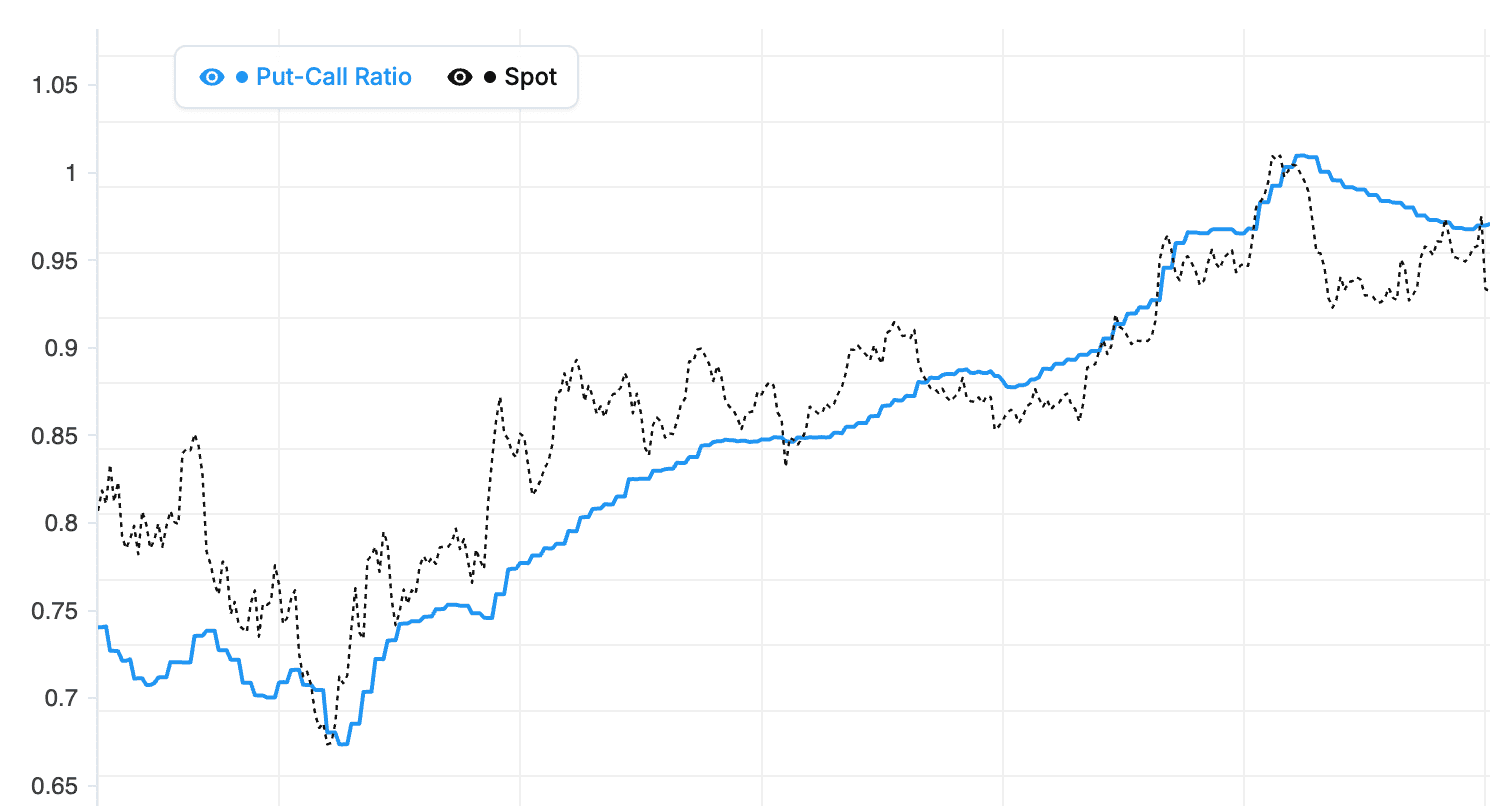
Our tool tracks SENSEX PCR every minute across all active expiries on NSE. You can view PCR as a time-series chart to see how sentiment is evolving through the session, compare weekly vs monthly expiry PCR (they often diverge around event risk), and overlay the underlying price to see where PCR leads or lags the market. Historical mode lets you replay PCR on any past SENSEX expiry to study how it behaved around results, RBI announcements, or major global events.
Reading SENSEX PCR levels
As a general guide on SENSEX: PCR below 0.7 signals heavy call writing and bearish tilt, 0.7 to 1.0 is a neutral-to-mildly-bearish zone, 1.0 to 1.3 is neutral-to-bullish, and above 1.3 signals strong put writing and bullish institutional positioning. But PCR turns contrarian at extremes. A PCR above 1.8 on SENSEX often marks exhaustion bullishness that leads to sharp reversals, and a PCR below 0.5 often marks capitulation bearishness that gets bought.
Use PCR alongside our Max Pain Calculator, Call vs Put OI Chart, and Open Interest Analysis to build a complete view ofSENSEX option-market positioning each trading session.
BSE Sensex (SENSEX) PCR Across Multiple Expiries
Why compare SENSEX PCR across different expiries?
Each SENSEX expiry has its own PCR. The current week's PCR reflects very short-term positioning. The current month's PCR reflects medium-term sentiment. Comparing them tells you whether traders agree or disagree across timeframes. If current-week PCR is 0.9 (mildly bearish) but current-month PCR is 1.3 (bullish), BSE Sensex is facing short-term resistance but medium-term support. This cross-expiry divergence is one of the more sophisticated PCR reads.
Reading SENSEX weekly vs monthly PCR
Weekly PCR moves faster and is noisier. It reflects the week's specific events and positioning. Monthly PCR is slower and more structural. It reflects how institutions are positioned for the entire month. When making short-term trading decisions (1-3 days), weekly PCR is more relevant. When making positional decisions (1-3 weeks), monthly PCR matters more. As a major Broad Market index on BSE, BSE Sensex typically has active OI at both weekly and monthly expiries.
Spotting rollover patterns in SENSEX PCR
In the days leading up to an expiry, traders roll positions to the next expiry. The PCR of the current expiry drops as positions unwind. The PCR of the next expiry builds up as new positions are created. By watching how PCR shifts across expiries during the rollover window, you see whether traders are maintaining their bias, increasing it, or reversing it. If current-month PCR was 1.2 and next-month PCR is forming at 1.4, the bullish lean is strengthening. At 1.0, it is weakening.
Using multi-expiry SENSEX PCR for positioning
A practical routine: check both current expiry and next expiry PCR at the start of each trading week. Note any divergences. If both are aligned (both high or both low), expect the bias to persist. If they diverge, the weaker timeframe usually converges toward the stronger one over the next 1-2 weeks. As of 6 October 2026, this multi-expiry comparison takes 2 minutes and provides a much clearer picture than looking at just the current expiry PCR.
BSE Sensex (SENSEX) PCR: Advanced Tips for Power Users
Tip 1: track SENSEX PCR rate of change
Advanced users do not just watch the PCR value — they watch the rate at which it is changing. A PCR moving from 1.0 to 1.1 slowly over the day is routine. A PCR moving from 1.0 to 1.2 in just 15 minutes is a significant event. Rapid changes often indicate institutional orders hitting the market. Set a mental threshold — any change above 0.1 in a 30-minute window on BSE Sensex warrants investigation.
Tip 2: compare SENSEX PCR to related symbols
Look at BSE Sensex PCR alongside the PCR of related symbols. For BSE Sensex, compare against other indices (NIFTY, SENSEX) to see if the sentiment move is isolated or broad-based. Broader alignment strengthens the signal; divergence suggests the move is specific to SENSEX.
Tip 3: watch for SENSEX PCR "reset" patterns
PCR rarely moves in a straight line. After a sustained trend, it usually "resets" — a sharp move in the opposite direction followed by resumption of the trend. If you see BSE Sensex PCR suddenly reverse after a strong multi-day trend, do not immediately assume the trend is over. Wait 2-3 sessions to see whether the reset leads to a new trend or the old trend resumes. Many false reversal trades come from reacting too quickly to a normal reset.
Tip 4: integrate SENSEX PCR into a simple daily checklist
Build a 5-point daily checklist: 1) Yesterday's SENSEX closing PCR. 2) Today's opening PCR. 3) Direction during the first hour. 4) Current PCR and trend. 5) Alignment or divergence with price action. Fill out this checklist at the end of each session and save it. Over time, you build a personal playbook that combines PCR with your specific trading style. As of 6 October 2026, this level of discipline is what separates traders who use PCR effectively from those who just glance at the number. As a major Broad Market index on BSE, BSE Sensex rewards this kind of consistent, structured analysis.
BSE Sensex (SENSEX) PCR: Common Mistakes to Avoid
Mistake 1: Reading SENSEX PCR in isolation
The most common mistake is looking at a single PCR number and drawing a conclusion. A PCR of 1.2 means different things in different contexts. Is it rising or falling? Is the broader market trending or range-bound? What is the price action? Without context, PCR is just a number. Always combine it with at least one other signal — price action, trend, or cross-expiry comparison — before acting on it.
Mistake 2: Applying fixed thresholds to BSE Sensex
Thresholds like "sell above 1.3" or "buy below 0.7" sound precise but fail often. Market regimes change. In some periods SENSEX PCR might stay above 1.3 for weeks without a correction, and in others it might reverse at 1.15. Rather than fixed thresholds, watch for trend changes and extremes relative to the recent history. As of 6 October 2026, adaptive thresholds work better than rigid rules.
Mistake 3: Confusing OI PCR with Volume PCR
Traders often quote "the PCR" without specifying whether they mean OI-based or Volume-based. These two metrics move at very different speeds and can give opposite signals in the same session. Always know which one you are looking at. Use OI PCR for structural analysis (multi-day) and Volume PCR for intraday signals. Mixing them up leads to confusion and missed trades on BSE Sensex.
Mistake 4: Chasing every SENSEX PCR extreme
Not every extreme reading warrants a trade. If SENSEX PCR reaches 1.4 during a strong uptrend, the contrarian short signal is very weak — you are fighting momentum. Be selective. Take contrarian trades only when the extreme appears in a range-bound or weakening trend environment. This selectivity dramatically improves win rates and reduces drawdowns on BSE Sensex trades.
Put Call Ratio: Video Walkthrough
SENSEX PCR levels: quick reference
| PCR range | Positioning | Common reading |
|---|---|---|
| Below 0.5 | Extreme call dominance | Capitulation-level bearishness; contrarian bounce risk |
| 0.5 to 0.8 | Call writers in control | Bearish-to-cautious sentiment on SENSEX |
| 0.8 to 1.2 | Balanced positioning | Neutral zone; no strong directional signal |
| 1.2 to 1.5 | Put writers in control | Bullish sentiment; lower strikes being defended |
| Above 1.5 | Extreme put dominance | Overheated bullishness; contrarian pullback risk |
These bands are statistical tendencies from NSE expiry data, not fixed rules. At extremes PCR works best as a contrarian signal. The live SENSEX chart above recalculates PCR every minute during market hours, so you can see in real time which band the market is trading in.
How to use the StockMojo Put Call Ratio tool
- Select an underlying — Choose Nifty, BankNifty, FinNifty, or an F&O stock from the symbol selector.
- Choose live or historical view — Use the live view for intraday signals; switch to historical to compare today's PCR with prior weeks and expiries.
- Read the current PCR-OI value — Compare the live PCR against the typical neutral band (0.85-1.10 for Nifty). Note whether you're inside, above, or below the band.
- Look at the trend — A rising PCR means put positioning is building. A falling one means calls are taking over. The trend matters more than the absolute number.
- Confirm with Max Pain and OI Buildup — Cross-check the PCR signal against the Max Pain target level and the Open Interest buildup classification before acting on a trade.
SENSEX Put Call Ratio — Frequently Asked Questions
What is SENSEX PCR today?
SENSEX PCR (Put Call Ratio) measures the ratio of put open interest to call open interest. A reading above 1 means more puts are open (bearish on the surface) and below 1 means calls dominate (bullish on the surface). Keep in mind that PCR works best as a contrarian indicator.
What is a good PCR for SENSEX?
For SENSEX, PCR between 0.8 and 1.2 is considered neutral. PCR above 1.3-1.5 is extremely bullish, though contrarians treat it as a sign of too many puts. PCR below 0.7 is bearish, with too many calls in the system. Extreme readings often precede reversals.
How to trade SENSEX using PCR?
Use SENSEX PCR as a contrarian indicator. A very high reading points to crowded put positioning that often resolves with a move up. A very low one warns of complacency on the call side and rising pullback risk. Confirm with price action before acting on either.
How often does SENSEX PCR update?
During NSE market hours (9:15 AM to 3:40 PM IST) the SENSEX PCR chart refreshes every minute from live option chain open interest. Outside market hours the chart shows the last traded session, and historical mode lets you replay SENSEX PCR for any past expiry.
What is the difference between OI-based and volume-based PCR for SENSEX?
OI-based PCR divides total put open interest by total call open interest and reflects outstanding positions, which makes it the preferred sentiment gauge for SENSEX. Volume-based PCR uses the day's traded contracts instead, so it reacts faster intraday but runs noisier. StockMojo's SENSEX PCR chart is OI-based, with change-in-OI and total-OI views.