SENSEX Timeseries Option Chain | Historical Snapshots & OI Replay
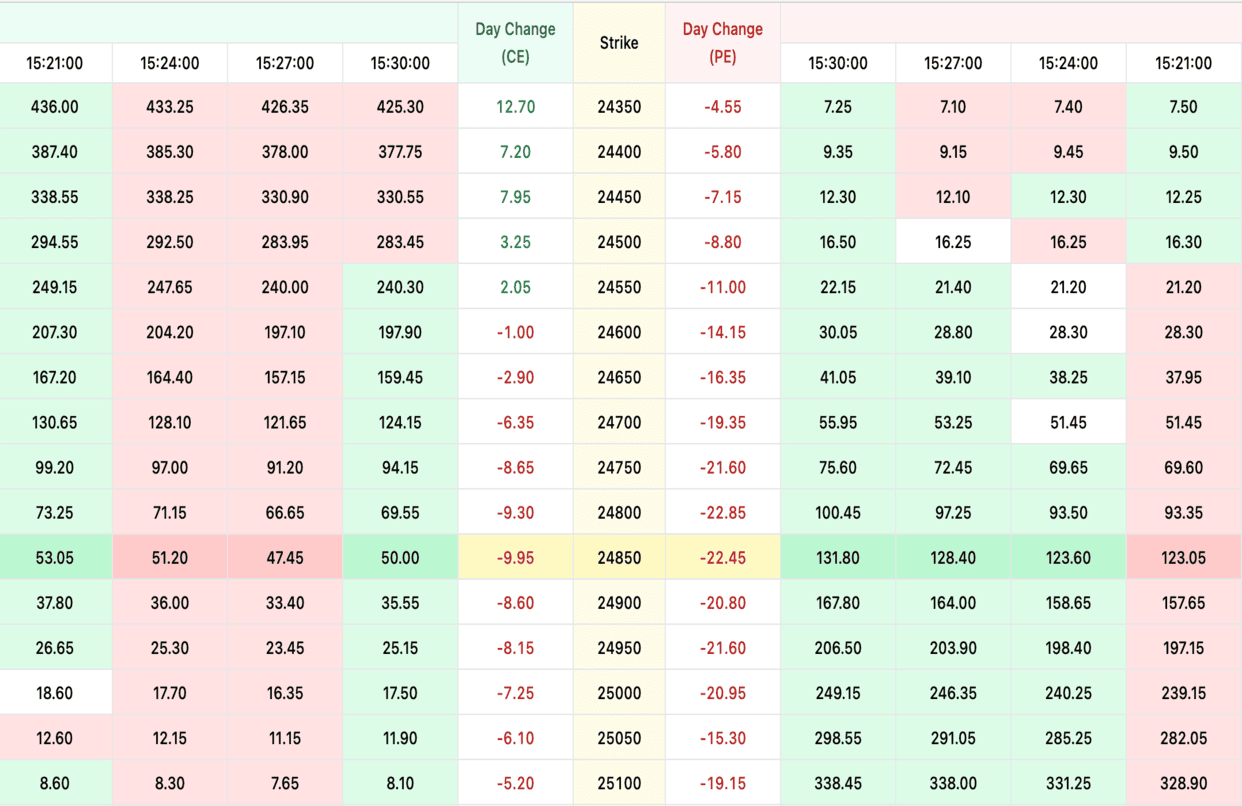
The timeseries option chain for SENSEX lets you pick any past trading date and any minute within that session, and replay the full option chain exactly as it looked — strike-by-strike open interest, volume, premiums, IV, and Greeks, all captured as they streamed live on NSE. Instead of looking at a single end-of-day snapshot, you can scrub through the day and watch how institutional positioning evolved in SENSEX options minute by minute.
This is a research-grade feature for SENSEX option traders. Back-test how max pain shifted in the final week of a monthly expiry. Study how option writers responded to a sharp intraday spike. Reconstruct OI buildup around a budget day, RBI policy, or an earnings announcement that moved SENSEX. The data you see in the chain is the same data live traders had at that moment — not a reconstructed estimate — so your conclusions about what worked, what failed, and why are built on actual historical market state.
Practical uses of the SENSEX timeseries option chain
Systematic traders use the SENSEX timeseries chain to build strategy back-tests that don't rely on end-of-day closes — most option strategies live or die on intraday behaviour. Discretionary traders use it to study specific past setups in detail: "How did the SENSEX option chain behave on the day of the last RBI decision?" is a question you can answer concretely instead of from memory. Journaling an old SENSEX trade becomes possible too — you can see exactly the option chain conditions you were looking at when you entered.
Pair the timeseries option chain with our Live Option Chain, Max Pain Calculator, and Open Interest Analysis for a complete SENSEX option-market research stack on NSE.
BSE Sensex (SENSEX) Timeseries Option Chain: Learning From Losses
Why review losing trades on SENSEX
Your own losing trades are the most valuable learning material. Review them with the Timeseries tool. What did the option chain show at the time? What signals did you miss? Was the setup actually weak? Honest review of losses accelerates improvement faster than dwelling only on winners.
Structured loss review on SENSEX
For each significant loss: pull up the option chain from your entry time using the Timeseries tool. Analyse what the data showed. Ask: "Did I have a good setup? What warning signs did I ignore? What would I do differently?" Document your answers for future reference.
Patterns in losses
After reviewing 20-30 losses, patterns emerge. Maybe you consistently enter too early on reversals. Maybe you ignore divergences. Maybe you size up when you should size down. Whatever the pattern, recognizing it is the first step to fixing it. Many traders plateau because they never systematically review their losses.
Turning losses into skill on SENSEX as of 13 October 2026
Losses are expensive tuition. Extracting maximum value from them through historical review is how you get your money's worth. The Timeseries tool is the textbook. Your loss log is the syllabus. Regular review is the study time. Do the work and your BSE Sensex trading will improve steadily over months.
BSE Sensex (SENSEX) Timeseries Option Chain: Backtesting Strategies
Why backtest SENSEX option strategies
Before committing real capital to an options strategy, it helps to see how it would have performed in the past. The Timeseries tool enables this by showing real historical BSE Sensex option data. You can mentally execute trades and check the outcomes. Backtesting refines your strategy before you risk money.
Simple backtesting approach on SENSEX
Pick a rule: "Sell an ATM straddle when IV is high and close after 2 days." Apply the rule to 10-20 past trading days using the Timeseries tool. Would it have worked? What was the average return? The answers tell you whether the strategy is worth trading live.
Limitations of manual backtesting
Manual backtesting is imprecise — you cannot test hundreds of days quickly, and your selection bias may favour certain periods. But even imperfect backtesting is better than no backtesting. The Timeseries tool supports informal validation that catches most obviously bad ideas before they cost you money.
Applying findings on SENSEX as of 13 October 2026
After backtesting, apply successful strategies to live BSE Sensex trades with modest size. Track performance. If live results match backtest expectations, scale up gradually. If they diverge significantly, investigate why — conditions may have changed. Backtesting is the starting point, not the endpoint, of strategy development.
BSE Sensex (SENSEX) Timeseries Option Chain: Strategy Refinement
Refining strategies with historical SENSEX data
When you have a trading strategy that sometimes works and sometimes does not, historical data helps refine it. Pull up past sessions where the strategy would have applied. Was the outcome better under specific conditions? That insight helps you filter out bad setups and focus on good ones.
Finding winning conditions
Study 20-30 past examples where your strategy could have applied. Separate them into winners and losers. What did the winners have in common? What conditions were absent in losers? These differences form refinement rules that improve your strategy's hit rate.
Eliminating losing conditions on SENSEX
If you find that your strategy consistently loses in certain conditions — specific IV levels, certain days of the week, event weeks — add filters to avoid those conditions. Refinement is about removing the bad trades, not just finding good ones. Fewer, higher-quality trades produce better results than more, lower-quality ones.
Continuous improvement on SENSEX as of 13 October 2026
Refinement never ends. As market conditions change, strategies that once worked may need new filters. Periodic review with the Timeseries tool keeps your strategies current. This continuous improvement process is what distinguishes lifelong profitable traders from those who stagnate.
SENSEX option chain evolution: quick reference
| Intraday pattern at a strike | How it looks on the replay | What it usually means |
|---|---|---|
| Steady OI build, flat/falling premium | OI rises through the day, premium drifts lower | Writers defending the strike — a wall forming (support at a put, resistance at a call) |
| OI and premium rising together | Both climb across the session | Buyers accumulating — positioning for a move toward that strike |
| Sudden OI unwind | OI drops sharply within minutes | Wall abandoned or short-covering; the level may no longer hold |
| OI flat, premium spiking | OI barely moves while premium jumps | IV expansion / fear around an event, not fresh positioning |
| OI and premium both falling | Both decline into the close | Long liquidation or profit-booking; interest leaving that strike |
| OI build migrating to a new strike | OI drains one strike and builds at the next | Wall being rolled — support/resistance shifting with spot |
Read the SENSEX chain like a movie, not a photo: the direction and speed of change at a strike reveals intent better than its size at any single moment. A wall built slowly and held all day is far more reliable than one that appears in the final hour. Scrub back to the open to see which strikes gained interest first.
How to use the Timeseries Option Chain
- Pick a symbol and a past date — Choose Nifty, BankNifty, or any F&O stock. Pick the trading date you want to study from the calendar.
- Choose the expiry to inspect — Weekly expiries replay differently from monthly. Match the expiry that was live on the date you picked.
- Scrub through the session — Use the time slider or playback controls to move minute by minute. Watch how OI, premium, and IV evolved through the day.
- Pause at the moments that matter — Stop at the 9:15 open, RBI announcement window, FII data release, or any moment that mattered to your trade. Read the chain as it was.
- Cross-reference with max pain or smart OI — Open the same date in our Max Pain or Smart OI tools to see how those signals were behaving alongside the chain.
SENSEX Timeseries Option Chain — Frequently Asked Questions
What is SENSEX timeseries option chain?
The SENSEX timeseries option chain replays historical snapshots of the NSE option chain at 1-minute granularity, so you can see how open interest, volume, premium and IV at each strike evolved through a past session. Instead of one end-of-day view, you scrub the whole day and watch when positions in SENSEX options were built or unwound.
How to use SENSEX timeseries data?
Pick a past date and expiry, then step through the session minute by minute. Watch a strike's open interest and premium together: a steady OI build with flat or falling premium means writers are defending that SENSEX level, while a sudden OI drop signals the wall being unwound. Pause at the open, event windows, or your old entry to read the chain as it was.
How do I spot an OI wall being built or abandoned in SENSEX?
Scrub forward and track one strike's open interest across the day. OI climbing hour after hour marks a wall being built — support at a put strike, resistance at a call strike. If that OI suddenly drops, the wall is being unwound or defended into expiry. Watching the SENSEX build-then-unwind sequence is far more telling than the closing number alone.
What does falling premium with rising OI mean on the SENSEX chain?
On the SENSEX timeseries chain, premium falling while a strike's open interest keeps rising is classic option writing — sellers are adding positions and pocketing decay, betting the level holds. When premium and OI rise together instead, buyers are accumulating, often ahead of an expected move. Replaying the minute-by-minute order of these changes shows which side was in control.
How often does the SENSEX timeseries chain update and how far back does it go?
Snapshots are stored at 1-minute intervals for every NSE session and go back multiple years for Nifty, BankNifty and major F&O names, with thinner coverage for recently added stocks. During market hours the current SENSEX session streams live; afterwards any past date can be replayed exactly as it printed, with no smoothing or interpolation.
Learn more
Read our guide: What Is an Option Chain? How to Read It (India Guide)