SENSEX Price vs Open Interest | Live Buildup & Unwinding
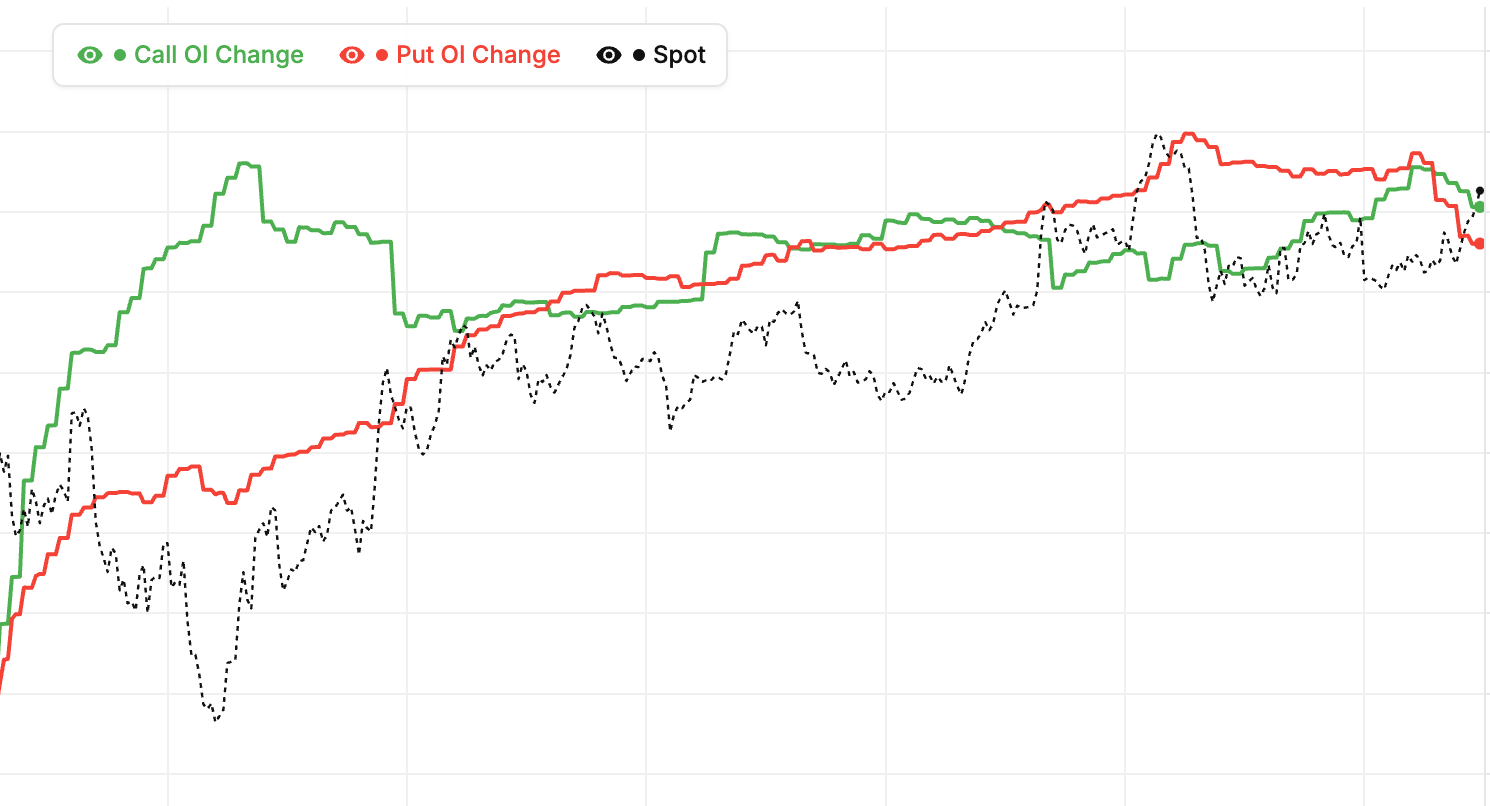
Price vs OI for SENSEX is the canonical framework for classifying what the market is actually doing beneath the surface of a price move. The four-phase cycle — long buildup, short buildup, long unwinding, and short covering — depends on whether price and open interest are moving together or apart. Our chart overlays SENSEX price and total option-chain OI so these phases become visible without any manual calculation.
Read the four states on SENSEX: price up with rising OI means fresh longs are being added (long buildup, genuinely bullish), price up with falling OI means shorts are exiting (short covering, technically bullish but usually shorter-lived), price down with rising OI means fresh shorts are entering (short buildup, genuinely bearish), and price down with falling OI means longs are capitulating (long unwinding, bearish but often close to exhaustion). The difference between buildup and covering is critical for judging whether a SENSEX move has legs or is about to stall.
Trading SENSEX divergences between price and OI
The most tradeable SENSEX signal is when price keeps moving but OI starts moving the other way. A SENSEX rally that continues even as OI declines is running on short-covering fuel — once shorts are done unwinding, the rally stalls. A SENSEX decline with falling OI is long unwinding — once longs have exited, selling pressure fades. These divergences often mark intraday tops and bottoms. Conversely, when price and OI keep moving together, the trend is supported by fresh positioning and tends to persist. Live mode tracks SENSEX price and OI in real time on NSE.
Combine Price vs OI with our Open Interest Analysis, Smart OI Detection, and Futures Intraday Chart for complete SENSEX positioning insight on NSE F&O.
BSE Sensex (SENSEX) Price vs OI: Reading Smart Money
How smart money shows in SENSEX Price vs OI
Institutional traders leave footprints on the chart. They build positions gradually — OI rises slowly and consistently over multiple days. They tend to act in specific time windows (first and last hour). Their activity usually shows as Long Buildup (bullish) or Short Buildup (bearish) rather than erratic patterns.
Identifying SENSEX accumulation
Accumulation is institutional buying — rising price with steadily rising OI over 3-5 sessions. Smart money is adding long positions patiently. For BSE Sensex, this pattern often precedes larger moves as institutional positioning completes. Align with the accumulation rather than fighting it.
Identifying SENSEX distribution
Distribution is institutional selling — falling price with rising OI (new shorts), or sideways price with rising OI (positions being built). Smart money is either shorting or unwinding longs. Distribution at the top of a rally often signals a reversal is coming. Respect it.
Following smart money on SENSEX as of 13 October 2026
The general rule: trade with institutional direction, not against it. The Price vs OI chart reveals institutional direction through buildup patterns. Over weeks, alignment with smart money produces consistently better results than trying to predict independently.
BSE Sensex (SENSEX) Price vs OI: Pro Tips
Tip 1: focus on strong patterns
Only trade on clear, strong Price vs OI patterns. Ambiguous or conflicting signals produce mediocre results. The discipline to wait for strong signals separates consistent winners from overactive traders. Quality beats quantity for BSE Sensex trades.
Tip 2: combine with multiple timeframes on SENSEX
Check the chart on multiple timeframes — intraday for timing, daily for trend, weekly for the broader context. When all three timeframes agree, you have a high-conviction setup. When they disagree, conservative action is best. Multi-timeframe analysis filters out many weak signals.
Tip 3: watch for pattern transitions
Transitions between patterns are more actionable than the patterns themselves. A Long Buildup transitioning to Long Unwinding is a specific exit signal for longs. Catching these transitions early gives you the best exit prices.
Tip 4: journal your SENSEX observations as of 13 October 2026
Daily notes build insight over time. After 60-90 days, you have a personal reference that no textbook matches. As a major Broad Market index on BSE, BSE Sensex rewards traders who develop their own edge through disciplined study and observation.
BSE Sensex (SENSEX) Price vs OI: Trending Market Analysis
What a trending SENSEX chart looks like
In trending conditions, BSE Sensex price moves consistently in one direction while OI rises in the same direction. The chart shows clean parallel lines — both price and OI rising together (uptrend) or both falling (downtrend, though this is less common since OI typically rises with short buildup).
Joining a SENSEX trend
Once you identify a confirmed trend (sustained price + OI alignment), the highest-probability trades are in the trend direction. Long positions during Long Buildup trends. Short positions during Short Buildup trends. Fighting the trend is usually a losing proposition — use the chart to stay aligned.
Trend exhaustion signs on SENSEX
Trends end when the supporting pattern breaks. Watch for OI stalling while price continues to move — this indicates no fresh money entering. The trend is losing fuel. A few sessions later, price typically reverses as the lack of support becomes obvious. The chart warns you early.
Trend trading discipline on SENSEX as of 13 October 2026
In trending markets, let winners run. Do not take profits early on short-term pullbacks. Use the Price vs OI chart to confirm the trend is still intact. Exit only when the pattern clearly breaks — OI starts falling, direction flips, or a divergence appears. Patient trend-following is one of the highest-reward approaches.
SENSEX option premium vs OI: quick reference
| Premium + OI | Option buildup | Read at the strike |
|---|---|---|
| Premium up + OI up | Long buildup | Fresh buyers lifting this SENSEX option — genuine demand at the strike |
| Premium down + OI up | Short buildup | Fresh writing on this contract — the strike is being capped or defended |
| Premium up + OI down | Short covering | Writers buying back — a premium pop that usually fades once covering ends |
| Premium down + OI down | Long unwinding | Option buyers exiting — interest draining out of the strike |
This matrix reads the premium of a single SENSEX option against its own open interest, so the StockMojo CE and PE Price vs OI panels tell you whether call writers or put writers are building positions at the selected strike. That is a different question from the underlying buildup shown in the price panel above — pair the two to judge whether the strike is likely to hold or break.
How to use Price vs OI analysis
- Choose symbol and time frame — Pick Nifty, BankNifty, or any F&O stock. Select live or historical mode.
- Classify the current phase — Check whether price and OI are both up (long buildup), both down (long unwinding), or divergent (short buildup or short covering).
- Look for divergences — The most tradeable signals come when price and OI diverge — these often mark intraday or multi-day reversals.
- Confirm with volume — Fresh buildup is most reliable when volume is also expanding. Buildup on thin volume is weaker commitment and fails more often.
- Time entries on phase transitions — The cleanest entries come at the moment a phase changes — for example, a shift from long unwinding to long buildup marks a regime change.
SENSEX Price vs OI — Frequently Asked Questions
What is SENSEX Price vs OI divergence?
SENSEX Price vs OI divergence is when price and open interest move in opposite directions instead of confirming each other. A rally that keeps rising while OI falls is short covering running out of fuel; a decline that continues while OI falls is long unwinding nearing exhaustion. Both patterns often precede a near-term reversal on NSE.
How to interpret SENSEX OI buildup?
Read SENSEX OI buildup with the four-quadrant matrix. Price up with OI up is long buildup (fresh bullish positioning); price down with OI up is short buildup (fresh bearish positioning); price up with OI down is short covering (a weaker rally); price down with OI down is long unwinding (a weaker decline).
Is SENSEX Price vs OI analysis reliable?
SENSEX Price vs OI analysis is reliable as a confirmation tool, not a standalone signal. Rising OI in the direction of a move confirms genuine commitment and follow-through, while falling OI warns the move is only position-squaring. It works best on clear moves of at least 0.3-0.5% and loses accuracy inside tight, choppy ranges.
What do the SENSEX call and put Price vs OI charts show?
The SENSEX call (CE) and put (PE) Price vs OI charts track each option's premium against its own open interest at the selected strike. Rising premium with rising OI signals fresh option buying at that strike; falling premium with rising OI signals fresh writing. Reading CE and PE side by side shows which side traders are defending.
How often does SENSEX Price vs OI data update?
During NSE market hours (9:15 AM to 3:40 PM IST) the SENSEX Price vs OI charts refresh every few seconds in sync with the live option chain and futures feed. Outside market hours they show the last traded session, and historical mode replays SENSEX price and OI for any past date at minute-level detail.
Learn more
Read our guide: Long Buildup vs Short Buildup: Reading OI Change with Price